
Schweißnaht
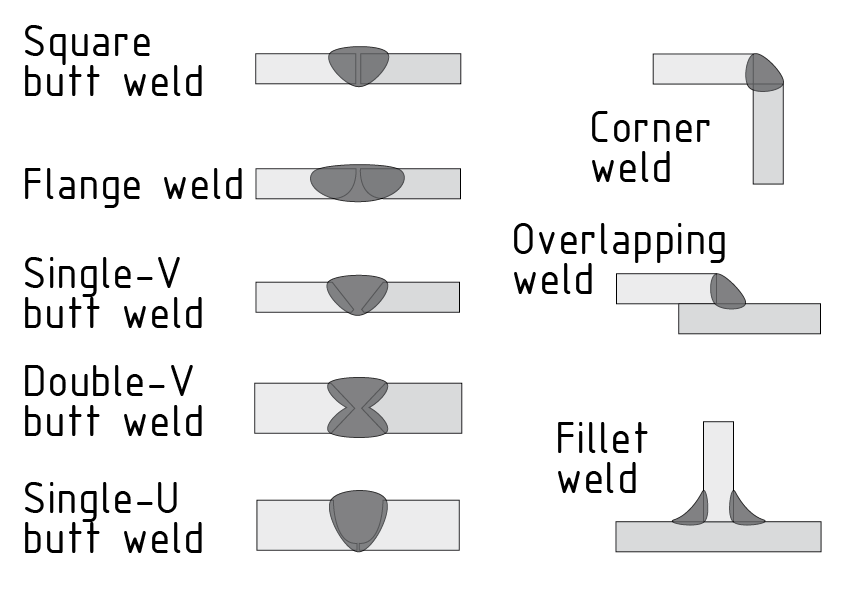
Eine Schweißnaht verbindet Bauteile stoffschlüssig an einem Schweißstoß. Die wichtigsten Schweißnähte sind Stumpf- und Kehlnähte, die je nach Einsatzzweck und Belastungsart (z. B. Zug, Schub, Druck, Biegedruck) verwendet werden.
Bei Stumpfnähten treffen Bauteile stumpf gegeneinander. Ab Blechdicken von drei Millimetern müssen die Nähte dabei beispielsweise durch Schleifen vorbereitet werden. Stumpfnähte zeigen wegen des ungestörten Kraftflusses nur eine geringe Kerbwirkung.
In Kehlnähten wird der Kraftfluss stark umgelenkt. Große Kerbwirkungen treten auf, die vor allem bei dynamischen Belastungen die Festigkeit ungünstig beeinflussen. Eine Nahtvorbereitung kann bei dicken Fügeteilen erforderlich sein.
Nahtanhäufungen sollten vermieden werden, weil sie zu mehrachsigen Spannungszuständen, Spannungsanhäufungen, Eigenspannungen, Rissen und Versprödung führen können.
-
Beispielsätze:
- Die Elektrodenhülle schützt die Schweißnaht vor Atmosphäre, der Kernstab bildet den Zusatzwerkstoff.
- Diese Wärme lässt die Werkstoffe an der Oberfläche schmelzen, sodass sich bei Abkühlung eine untrennbare Verbindung, die Schweißnaht, ergibt.

weld
-
Example sentences:
- In practice, profile members meet at panel points or gusset plates that are joined using bolts, rivets or welded seams.
- Transport trolleys made from welded steel frames are usually very heavy.
- In this method, too, the welding process is protected by an inert gas.
- Additionally, cross bracing can be welded in to ensure a more even distribution of loads.
Weld seam
A weld seam is a Bonded connection between components at a weld Joint. The most important types are butt and fillet welds. Which one is used depends on the relevant application and load type (e.g. tensile, shear or compressive load or Bending pressure).
In the case of butt welds, components are virtually parallel. Weld seams need to be prepared, for example by Grinding, when the metal sheets are three millimetres or more thick. Since they do not disrupt the flow of Force, butt welds exhibit only a minor Notch effect.
Fillet welds significantly disrupt the flow of force. The large notch effects that occur have a negative impact on the weld Strength, especially in the case of dynamic loads. It may be necessary to prepare the weld seam if the parts to be joined are thick.
An accumulation of weld seams should be avoided, because they can lead to multiaxial stress states, stress accumulations, internal stresses, cracks and embrittlement.
Weld seam
A weld seam is a Bonded connection between components at a weld Joint. The most important types are butt and fillet welds. Which one is used depends on the relevant application and load type (e.g. tensile, shear or compressive load or Bending pressure).
In the case of butt welds, components are virtually parallel. Weld seams need to be prepared, for example by Grinding, when the metal sheets are three millimetres or more thick. Since they do not disrupt the flow of Force, butt welds exhibit only a minor Notch effect.
Fillet welds significantly disrupt the flow of force. The large notch effects that occur have a negative impact on the weld Strength, especially in the case of dynamic loads. It may be necessary to prepare the weld seam if the parts to be joined are thick.
An accumulation of weld seams should be avoided, because they can lead to multiaxial stress states, stress accumulations, internal stresses, cracks and embrittlement.
welded seam
-
Example sentences:
- In practice, profile members meet at panel points or gusset plates that are joined using bolts, rivets or welded seams.
welding seam

cordón de soldadura
soldado
unión soldada

焊接