
Deutsch

Gleitreibung (Feminin)

Beschreibung:

Die Gleitreibung ${{F}_{H}}$ ist eine bei der Gleitung auftretende hemmende Kraft, welche sowohl von den Oberflächenbeschaffenheiten als auch den Materialeigenschaften der aufeinander gleitenden Körper abhängig ist. Die Gleitreibungszahl ${{\mu }_{R}}$ ist ein Maß für die Gleitreibung.

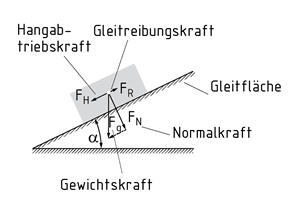
Ein Körper kann sowohl auf einer ebenen Fläche als auch einer schiefen Ebene Gleitreibung erfahren. Die Gleitreibungskraft ${{F}_{R}}$ ist der Bewegungsrichtung des gleitenden Körpers entgegen gerichtet und parallel zur Gleitfläche. Senkrecht dazu steht die Normalkraft FN .

${{F}_{H}}={{\mu }_{G}}\cdot {{F}_{N}}$

Ein sich auf einer schiefen Ebene befindender Körper bewegt sich hangabwärts $(v>0)$, wenn die auf ihn wirkende Hangabtriebskraft FH größer als die Gleitreibungskraft FR ist. Die Hangabtriebskraft hängt von dem Neigungswinkel $\alpha $ und der Gewichtskraft ${{F}_{G}}$ ab: ${{F}_{H}}={{F}_{G}}\cdot \sin \alpha $ .
    Beispielsätze:
  • Ein Körper kann sowohl auf einer ebenen Fläche als auch einer schiefen Ebene Gleitreibung erfahren.
  • Sie sind in die Profilnuten einsetzbar, verschleißfest und haben einen geringen Gleitreibungskoeffizienten.
  • Die Gleitreibungskraft FR ist der Bewegungsrichtung des gleitenden Körpers entgegen gerichtet und parallel zur Gleitfläche.

English

dynamic friction (Neutrum)

English

kinetic friction (Neutrum)

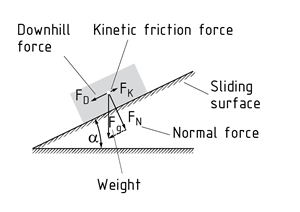
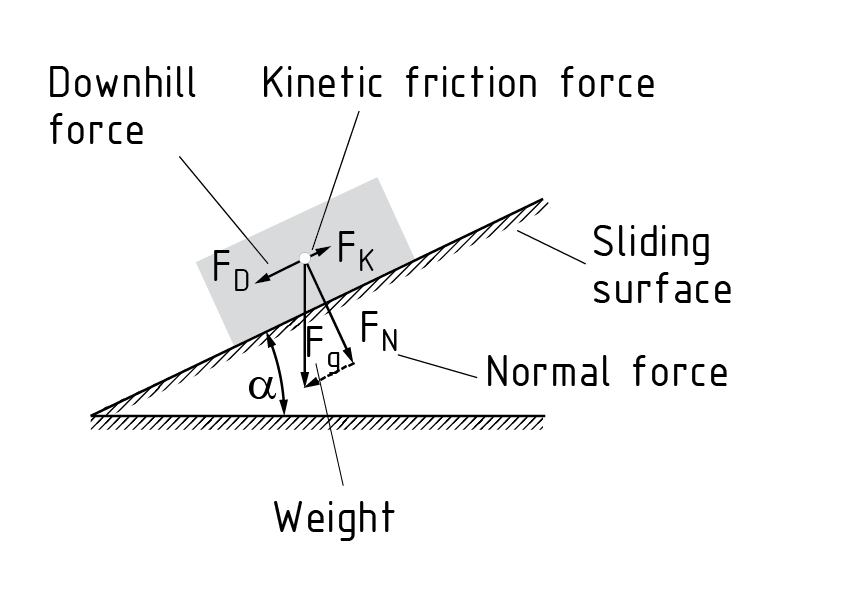
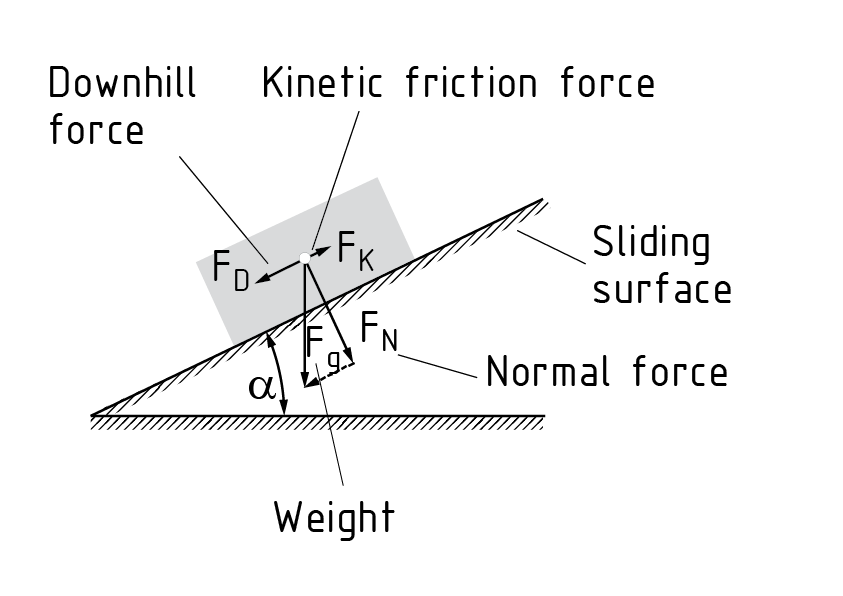
Description: Kinetic friction ${{F}_{f}}$ is an inhibitive Force that occurs during a sliding motion. It varies according to the surface attributes and Material properties of the bodies that are sliding against each other. The coefficient of kinetic friction ${{\mu }_{K}}$ is used to quantify kinetic friction. A body can be subjected to kinetic Friction on both a level surface and an inclined surface. The kinetic friction force ${{F}_{K}}$ travels in the opposite direction to the sliding body and parallel to the sliding surface. Normal force ${{F}_{N}}$ is perpendicular to the kinetic friction force. ${{F}_{f}}={{\mu }_{K}}\cdot {{F}_{N}}$ A body on an inclined plane will move down the slope $(v>0)$ if the downhill force FD is greater than the kinetic friction force FK. Downhill force varies according to angle of incline $\alpha $ and weight ${{F}_{G}}$: ${{F}_{D}}={{F}_{G}}\cdot \sin \alpha $ .
    Example sentences:
  • A body can be subjected to kinetic friction on both a level surface and an inclined surface.
  • The kinetic friction force FK travels in the opposite direction to the sliding body and parallel to the sliding surface.
  • A body on an inclined plane will move down the slope if the downhill force FD is greater than the kinetic friction force FK.
English

sliding friction (Neutrum)

Description: They can be fitted into the profile grooves, are hard-wearing and have a low coefficient of sliding friction. The Slide Strips serve as slide elements when transporting goods or workpiece carriers, for example. They can be fitted into the profile grooves, are hard-wearing and have a low coefficient of sliding friction.

    Example sentences:
  • They can be fitted into the profile grooves, are hard-wearing and have a low coefficient of sliding friction.
  • They can be fitted into the profile grooves, are hard-wearing and have a low coefficient of sliding friction.
Spanisch

fricción cinética (Neutrum)

Description: La fricción cinética ${{F}_{f}}$ es una fuerza inhibidora que ocurre durante un movimiento de deslizamiento. Varía de acuerdo con los atributos de la superficie y las propiedades del material de los cuerpos que se deslizan entre sí. El coeficiente de fricción cinética ${{\mu }_{K}}$ se usa para cuantificar la fricción cinética. Un cuerpo puede someterse a la fricción cinética tanto en una superficie nivelada como en una superficie inclinada. La fuerza de fricción cinética ${{F}_{K}}$ viaja en la dirección opuesta al cuerpo que se desliza y paralela a la superficie de deslizamiento. La fuerza normal ${{F}_{N}}$ es perpendicular a la fuerza de fricción cinética. ${{F}_{f}}={{\mu }_{K}}\cdot {{F}_{N}}$ Un cuerpo en un plano inclinado se moverá hacia abajo por la pendiente $(v>0)$ si la fuerza descendente FD es superior a la fuerza de fricción cinética FK. Las fuerzas descendentes varían de acuerdo con el ángulo de inclinación $\alpha $ y el peso ${{F}_{G}}$: ${{F}_{D}}={{F}_{G}}\cdot \sin \alpha $ . Fricción cinética en un plano inclinado
Spanisch

fricción dinámica (Neutrum)

Spanisch

fricción por deslizamiento (Neutrum)

Chinesisch

动摩擦 (Neutrum)

Description: 滑动时产生的阻碍作用力称为动摩擦力 ${{F}_{f}}$。动摩擦随着相互滑动物体的表面属性和材料性能而变化。动摩擦系数 ${{\mu }_{K}}$ 用来量化动摩擦力的大小。 无论在平面还是斜面上,物体都会受到动摩擦的影响。动摩擦力 ${{F}_{K}}$ 与滑动面相切,与物体运动方向相反。法向力 ${{F}_{N}}$ 与动摩擦力垂直。 ${{F}_{f}}={{\mu }_{K}}\cdot {{F}_{N}}$ 当下坡力FD大于动摩擦力FK时,斜面上的物体将沿着坡体下移 $(v>0)$。下坡力随着斜坡倾斜角度和物体重量的变化而改变。 ${{F}_{G}}$: ${{F}_{D}}={{F}_{G}}\cdot \sin \alpha $ . 斜面上的动摩擦力
Chinesisch

滑动摩擦 (Neutrum)