

Kleben
Kleben ist ein wärmearmes Fügeverfahren, bei dem Bauteile mit einer Schicht von Klebstoffen stoffschlüssig verbunden werden. Klebstoffe sind nichtmetallische Werkstoffe, die flüssig, mitunter auch fest vorliegen. Sie können mineralisch (etwa Silikate wie Wasserglas) oder organisch (z. B. Schmelzklebstoffe oder Reaktionskleber als 2-Komponenten-Kleber) sein.
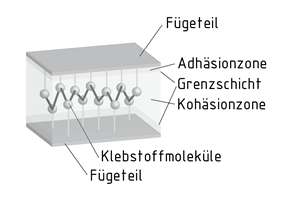
Klebstoff haftet an Bauteilen durch molekulare Wechselwirkungen in der Grenzschicht (Adhäsion durch Benetzung und Kraftschlüssigkeit) und verbindet sie durch innere Festigkeit (Kohäsion). Ein Diffusionsprozess an der Grenzfläche findet nicht statt.
Klebeverbindungen haben geringere Festigkeiten als Löt- oder Schweißverbindungen, eignen sich aber auch für großflächige Verbindungen (Laminate, Bauteilverstärkungen). Fast alle Werkstoffe, auch unterschiedliche, können mit einem abgestimmten Klebstoff verbunden werden.
Geklebt wird, wenn es auf schonende Verarbeitung ankommt, bei der Verzug, Abkühlspannung oder Gefügeveränderungen der Bauteile vermieden werden müssen. Ungeeignet ist das Verfahren dagegen für Verbindungen, die Alterungsprozessen (UV-Licht) oder zerstörenden Temperaturen bzw. Chemikalien ausgesetzt sind. Zusatzmittel (Reinigungsmittel, Härter, Haftvermittler) und Klebstoffe zählen häufig zu den Gefahrstoffen.
-
Beispielsätze:
- Das Material ist einseitig mit Kautschukkleber selbstklebend ausgerüstet.
- Auf der Rückseite ist das Schalldämmmaterial selbstklebend ausgerüstet, so dass die Verarbeitung besonders einfach ist.
- Beim Einsatz im Profilsystem XMS stellt ein selbstklebender Türdichtprofil-Abschnitt eine durchgehende, umlaufende Dichtung sicher.

adhere
-
Example sentences:
- Acceleration causes the sand to adhere closely to the model.
- Static friction is a force between two mutually adherent bodies.
- dimensions are adhered to.
Adhesive bonding
Adhesive bonding is a low-heat Joining method in which a Bonded connection is created between components using a layer of adhesives. Adhesives are non-metallic substances in liquid and, sometimes, solid form. They can be mineral (e.g. silicates such as water glass) or organic (e.g. hotmelt adhesives or reactive adhesives in the form of two-component adhesives).
Adhesive adheres to components as a result of molecular interactions in the boundary layer (adhesion due to wetting and a Friction-based connection) and bonds them as a result of internal Strength (cohesion). The interface is not subject to a diffusion process.
Adhesive joints are not as strong as soldered or welded joints but are also suitable for bonding over a large surface area (laminates, component reinforcement). Virtually all materials, including combinations of different materials, can be joined together using an appropriate adhesive.
Adhesive bonding is used when processing needs to be gentle and not result in any distortion, cooling stress or structural changes in the components. However, it is unsuitable for joints that are subject to ageing processes (UV light) or destructive temperatures and/or chemicals. Additives (cleaning agents, hardeners, adhesion promoters) and adhesives are often classified as hazardous substances.
Adhesive bonding
Adhesive bonding is a low-heat Joining method in which a Bonded connection is created between components using a layer of adhesives. Adhesives are non-metallic substances in liquid and, sometimes, solid form. They can be mineral (e.g. silicates such as water glass) or organic (e.g. hotmelt adhesives or reactive adhesives in the form of two-component adhesives).
Adhesive adheres to components as a result of molecular interactions in the boundary layer (adhesion due to wetting and a Friction-based connection) and bonds them as a result of internal Strength (cohesion). The interface is not subject to a diffusion process.
Adhesive joints are not as strong as soldered or welded joints but are also suitable for bonding over a large surface area (laminates, component reinforcement). Virtually all materials, including combinations of different materials, can be joined together using an appropriate adhesive.
Adhesive bonding is used when processing needs to be gentle and not result in any distortion, cooling stress or structural changes in the components. However, it is unsuitable for joints that are subject to ageing processes (UV light) or destructive temperatures and/or chemicals. Additives (cleaning agents, hardeners, adhesion promoters) and adhesives are often classified as hazardous substances.
bond
-
Example sentences:
- Take measurements for all the relevant parts to the protective earth (PE) or the earth bonding point (EBP).
- An EBP (Earth Bonding Point) with corresponding marking is also available for use in the profile groove as a central collection point for dissipated electrostatic charges.
- The safety of electronic components is also taken care of - an EBP (earth bonding point) connection is included as standard to ensure static charges (ESDs) are safely dissipated.
- The screw connection creates a conductive bond between the conduit elements.
- The individual layers bond to form a complex part that hardens on cooling.
- Natural sands, synthetic sands or resin-bonded sands are used for the moulds.
bonding
-
Example sentences:
- Take measurements for all the relevant parts to the protective earth (PE) or the earth bonding point (EBP).
- An EBP (Earth Bonding Point) with corresponding marking is also available for use in the profile groove as a central collection point for dissipated electrostatic charges.
- The safety of electronic components is also taken care of - an EBP (earth bonding point) connection is included as standard to ensure static charges (ESDs) are safely dissipated.
cement
-
Example sentences:
- This also applies to the placement of partitions and shelves.
- This translates into a high load-bearing capacity that resists displacement.
- It can withstand no more than 1/3 the displacement force than a Standard Fastener can resist.
glue
-
Example sentences:
- This comprises strips of veneer glued in a criss-cross and layer-by-layer process.
- The tool labels are to be permanently riveted (not glued) in place.
- The product name Diana for folding-box gluers will to be retained.
gluing
paste
-
Example sentences:
- Laufbahn-Öl und Montagepaste sind für den Kontakt mit Lebensmitteln zugelassen.
- Track Oil and Assembly Paste are approved for contact with foodstuffs.
- Läppen ist ein spanendes Fertigungsverfahren mit losem, in Pasten oder Flüssigkeiten verteiltem Korn.
stick
-
Example sentences:
- These small stickers are used primarily for labelling panel elements, roller conveyors, etc.
- One way of improving fracture toughness - in aircraft manufacturing, for example - is to stick layered stiffeners onto the sheet metal.
- Bauartbedingt neigen Gleitführungen insbesondere bei geringen Geschwindigkeiten und erhöhter Belastung zu leicht ungleichförmigem Lauf (Stick-Slip-Effekt).

adherir
cementar
engomado
pegar
unión
Unión adhesiva
La unión adhesiva es un de bajo calor en el cual la conexión se crea entre dos componentes usando una capa de adhesivos. Los adhesivos son sustancias no metálicas en forma líquida y, a veces, sólida. Pueden ser minerales (por ejemplo, silicatos como tipo waterglass) u orgánicos (por ejemplo, adhesivos de fusión en caliente o adhesivos reactivos en la forma de adhesivos de dos componentes).
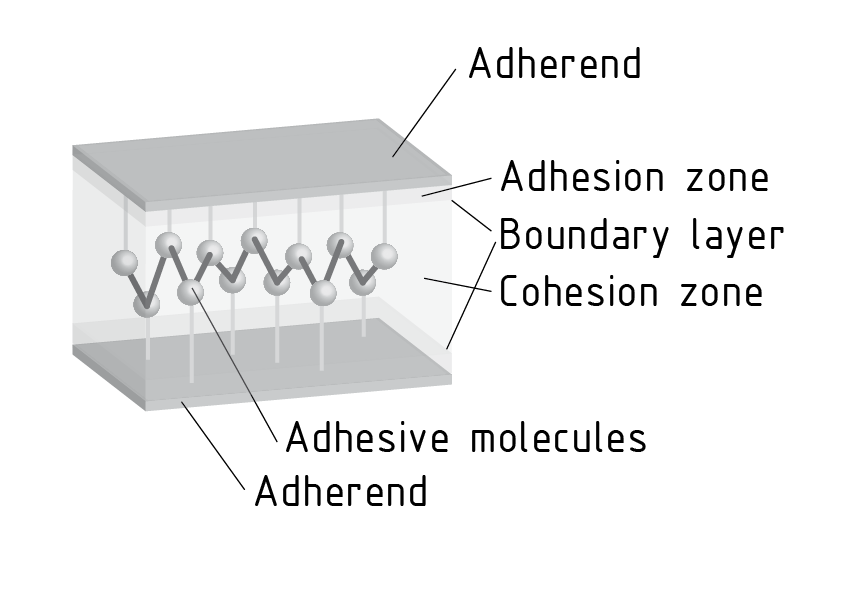
El adhesivo se adhiere a los componentes como resultado de las interacciones moleculares de la capa límite (adhesión debido al humedecimiento y una conexión a base de fricción) y los liga como resultado de la resistencia interna (cohesión). La interfaz no está sujeta a un proceso de difusión.
Las uniones adhesivas no son tan fuertes como las o , pero son adecuadas para unir grandes áreas de superficie (laminados, componentes de refuerzo). Prácticamente todos los materiales, incluso las combinaciones de diferentes materiales, pueden ser unidos con un adhesivo adecuado.
La unión adhesiva se usa cuando el procesamiento debe ser suave y no resultar en una distorsión, esfuerzo de enfriamiento o cambios estructurales en los componentes. Sin embargo, no son adecuadas para uniones que están sujetas a procesos de envejecimiento (luz UV) o a temperaturas o productos químicos destructivos. Los aditivos (agentes de limpieza, endurecedores, promotores de adhesión) y los adhesivos a menudo se clasifican como sustancias peligrosas.
Capas en la unión adhesiva
Unión adhesiva
La unión adhesiva es un de bajo calor en el cual la conexión se crea entre dos componentes usando una capa de adhesivos. Los adhesivos son sustancias no metálicas en forma líquida y, a veces, sólida. Pueden ser minerales (por ejemplo, silicatos como tipo waterglass) u orgánicos (por ejemplo, adhesivos de fusión en caliente o adhesivos reactivos en la forma de adhesivos de dos componentes).
El adhesivo se adhiere a los componentes como resultado de las interacciones moleculares de la capa límite (adhesión debido al humedecimiento y una conexión a base de fricción) y los liga como resultado de la resistencia interna (cohesión). La interfaz no está sujeta a un proceso de difusión.
Las uniones adhesivas no son tan fuertes como las o , pero son adecuadas para unir grandes áreas de superficie (laminados, componentes de refuerzo). Prácticamente todos los materiales, incluso las combinaciones de diferentes materiales, pueden ser unidos con un adhesivo adecuado.
La unión adhesiva se usa cuando el procesamiento debe ser suave y no resultar en una distorsión, esfuerzo de enfriamiento o cambios estructurales en los componentes. Sin embargo, no son adecuadas para uniones que están sujetas a procesos de envejecimiento (luz UV) o a temperaturas o productos químicos destructivos. Los aditivos (agentes de limpieza, endurecedores, promotores de adhesión) y los adhesivos a menudo se clasifican como sustancias peligrosas.
Capas en la unión adhesiva
unir

使粘附
使结合
接合剂
粘合
粘结
粘结是一种低热能的,使用胶粘剂层在部件之间产生粘合连接。胶粘剂是液体的非金属物质,有时是固体形式。其可以是矿物(例如水玻璃等硅酸盐)或有机物(例如热熔粘合剂或双组分反应活性胶粘剂)。
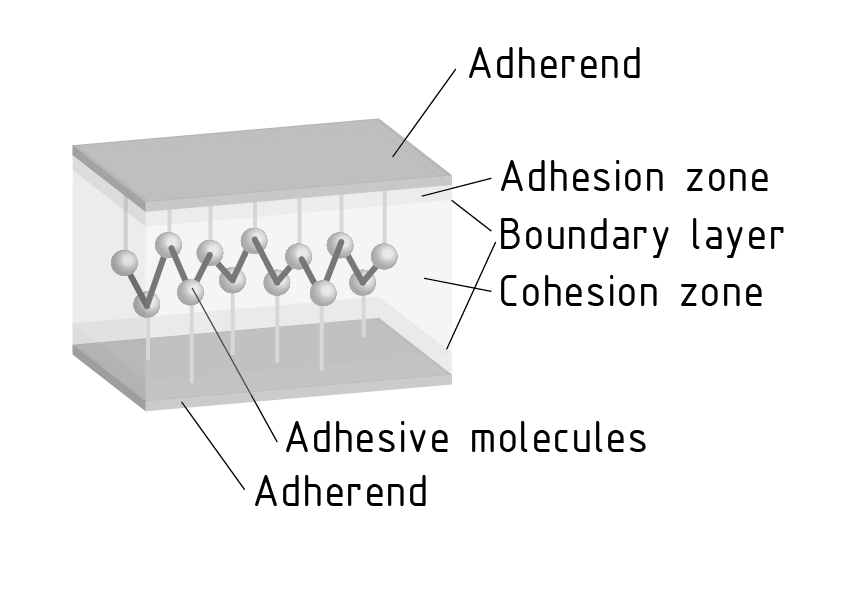
粘结是边界层的分子相互作用的结果(附着力是由于润湿和摩擦作用的连接),其内部强度将其粘接在一起(内聚力)。边界面不发生扩散过程。
粘接接合没有或的强度大,但也适用于大表面区域的结合(层压材料、部件加固)。几乎所有的材料,包括不同材料的组合,都可以通过适当的胶粘剂结合在一起。
粘结适用于需要温和加工且不产生任何畸变、冷却应力或结构变化的过程。然而,不适合经受老化过程(紫外光)或破坏性温度和/或化学品的粘结。添加剂(清洁剂、硬化剂、增粘剂)和胶粘剂往往被列为有害物质。
粘结层
近义词
热熔粘合剂
内聚力
附着力
粘结
粘结是一种低热能的,使用胶粘剂层在部件之间产生粘合连接。胶粘剂是液体的非金属物质,有时是固体形式。其可以是矿物(例如水玻璃等硅酸盐)或有机物(例如热熔粘合剂或双组分反应活性胶粘剂)。
粘结是边界层的分子相互作用的结果(附着力是由于润湿和摩擦作用的连接),其内部强度将其粘接在一起(内聚力)。边界面不发生扩散过程。
粘接接合没有或的强度大,但也适用于大表面区域的结合(层压材料、部件加固)。几乎所有的材料,包括不同材料的组合,都可以通过适当的胶粘剂结合在一起。
粘结适用于需要温和加工且不产生任何畸变、冷却应力或结构变化的过程。然而,不适合经受老化过程(紫外光)或破坏性温度和/或化学品的粘结。添加剂(清洁剂、硬化剂、增粘剂)和胶粘剂往往被列为有害物质。
粘结层
近义词
热熔粘合剂
内聚力
附着力
粘贴