
d'Alembert'sche Prinzip

d'Alembert principle
d'Alembert's principle
Description:
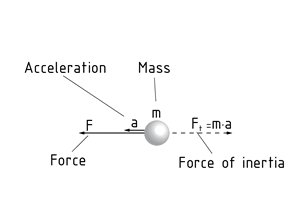
The principle of d'Alembert is used to calculate a dynamic system from a static perspective. Introducing a Force of inertia ${{F}_{\tau }}$ (d'Alembert's auxiliary force) as a fictitious force creates an Equilibrium in the system, because the sum of the external forces ${{F}_{R}}$ corresponds to the force of inertia ${{F}_{\tau }}$. The force of inertia is caused by the mass m of the dynamic system and therefore acts at its Centre of gravity. The force of inertia acts in the opposite direction to the acceleration a and thus to the system's motion. It is the product of mass m and acceleration a. Since the system to be calculated is assumed to be moving in a positive direction, the force of inertia is preceded by a negative sign. The following applies: ${{F}_{\tau }}=-m\cdot a$