

Energie
-
Beispielsätze:
- Bei bewegtem Schlitten ist eine Energieführungsketten vorzusehen.
- Für die geplante Anlage ist ein Energiespar-Konzept nachzuweisen.
- Bei bewegtem Schlitten ist eine Energieführungskette erforderlich.

energy
Description:
Evidence of an energy-saving concept shall be provided for the planned plant. Brakes usually convert mechanical kinetic energy into heat energy. This potential energy content is stored in the deformed body.
-
Example sentences:
- Evidence of an energy-saving concept shall be provided for the planned plant.
- Brakes usually convert mechanical kinetic energy into heat energy.
- This potential energy content is stored in the deformed body.
power
Description:
Power is the Work $\Delta W$ and/or energy $\Delta E$ that is implemented over a specific period of time $\Delta t$. Power P is measured in $Nm/s$ or W (watts). It is important in both Mechanics and as electrical power. It is calculated using the formula $P(t)=\frac{\Delta W}{\Delta t}$ or $P(t)=\frac{dW}{dt}$. In the case of a translational movement, power P is the product of the Force vector $\overrightarrow{F}$ and the Velocity vector $\overrightarrow{v}$ that is acting in the same direction. In the case of a Rotation, it is the product of angular velocity $\overrightarrow{\omega }$ and moment $\overrightarrow{M}$. In hydraulics, power is obtained by multiplying the volumetric flow rate Q by pressure p.
-
Example sentences:
- Always disconnect the Light Fitting from its power source before conducting any maintenance or repair work.
- One wheel is powered and is also used for steering and braking.
- Luminous flux describes the power of a light source.
work
Description:
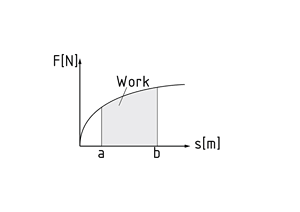
Work W is the effect of a Force F on a body over a specific displacement d. It is measured in the SI unit of J (joules). In mathematical terms (and assuming the force is constant), work can be calculated from the scalar product of force \[\overrightarrow{F}\] and displacement covered \[\overrightarrow{s}\]: \[W=\overrightarrow{F}\cdot \overrightarrow{s}\]. If the force is not constant over the course of the displacement, the work that is done is depicted by an area below the line (mathematically: integral with the boundaries a and b) in a force-displacement diagram. A force that is applied perpendicular to the trajectory does not result in any work on the body. Only the tangential component of a force results in work. Work and energy are closely related. Energy is stored work. Work that is done is converted into energy. Work can be broken down into the following types: Lifting work W(l) Acceleration work W(v) Work of deformation W(t) Frictional work W(t)
-
Example sentences:
- Always disconnect the Light Fitting from its power source before conducting any maintenance or repair work.
- Sturdy Light Fitting for illumination of workplaces and machines.
- Always set down the height-adjustable work bench on a level surface.
- The transfer systems are permanently connected to the work benches.

energía
trabajo
Description:
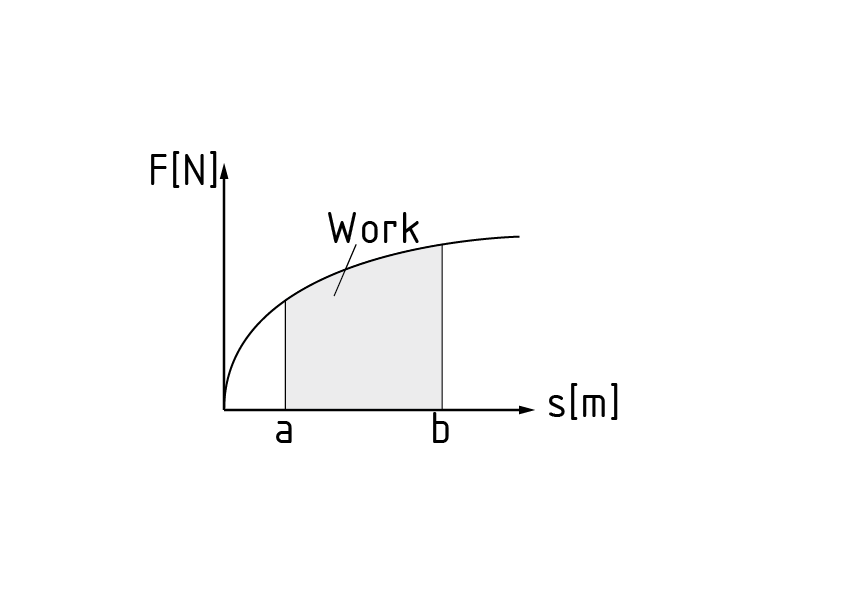
El trabajo W es el efecto de una fuerza F en un cuerpo sobre un desplazamiento específico d. Se mide en la unidad del SI de J (joules). En términos matemáticos (y asumiendo que la fuerza es constante), el trabajo puede calcularse a partir del producto escalar de la fuerza $\overrightarrow{F} $ y el desplazamiento cubierto $\overrightarrow{s} $ : $W=\overrightarrow{F}\cdot \overrightarrow{s} $ . Si la fuerza no es constante durante el curso del desplazamiento, el trabajo que se hace es representado por un área debajo de la línea (matemáticamente: integral con límites a y b) en un diagrama fuerza-desplazamiento. Una fuerza que es aplicada perpendicularmente a la trayectoria no resulta en ningún trabajo en el cuerpo. Solo el componente tangencial de una fuerza resulta en trabajo. El trabajo y la energía están estrechamente relacionados. La energía es trabajo almacenado. El trabajo que se realiza es convertido en energía. El trabajo puede desglosarse en los siguientes tipos: Trabajo de elevación W(l) Trabajo de aceleración W(v) Trabajo de deformación W(f) Trabajo de fricción W(t) Trabajo representado como un área en un diagrama fuerza-desplazamiento

功率
Description:
功率是指物体在单位时间内做的功$\Delta W$或转化的能量 $\Delta E$ 。功率P以 $Nm/s$ 或 W (瓦特)来表示。不论是在力学中还是以电功率形式存在,功率都非常重要。 功率可由公式 $P(t)=\frac{\Delta W}{\Delta t}$ 或 $P(t)=\frac{dW}{dt}$ 计算。 在平移运动中,功率P是在作用方向相同的力矢量 $\overrightarrow{F}$ 和速度矢量 $\overrightarrow{v}$ 的共同作用下产生的。. 在转动情况下,功率在是角速度 $\overrightarrow{\omega }$ 和力矩 $\overrightarrow{M}$ 的作用下产生的。在液压传动系统中,功率等于流量和压力的乘积。
工作