

Fahrwiderstand

rolling resistance
Description:
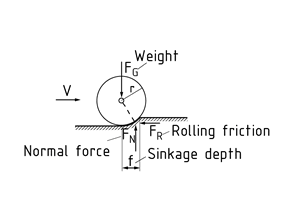
Rolling friction is a Resistance that results from the deformation that occurs in a rolling element (cylinder, ball, wheel) and surface when the element rolls over the surface. Rolling friction is therefore also referred to as rolling resistance. The Strength of rolling friction varies according to the surface attributes, compliance and hardness of the rolling element and surface. As in the case of all other Friction scenarios, a specific parameter is involved, in this case the coefficient of rolling friction ${{\mu }_{R}}$. This parameter can be determined from the following correlation: ${{\mu }_{R}}=f/r$, where r is the radius of the ball and f is the sinkage depth. Sinkage depth is illustrated in the figure below. It is also known as the 'lever arm of rolling friction'.
-
Example sentences:
- Roll the tool along the Profile until there is no discernible rolling resistance.
- Perfect for transporting sensitive or delicate goods and with extremely low rolling resistance.
- The rollers can even cope well with crates that have awkward or irregular bases, since low rolling resistance keeps everything running smoothly and provides a high load-carrying capacity.
tractive resistance

resistencia a la rodadura
Description:
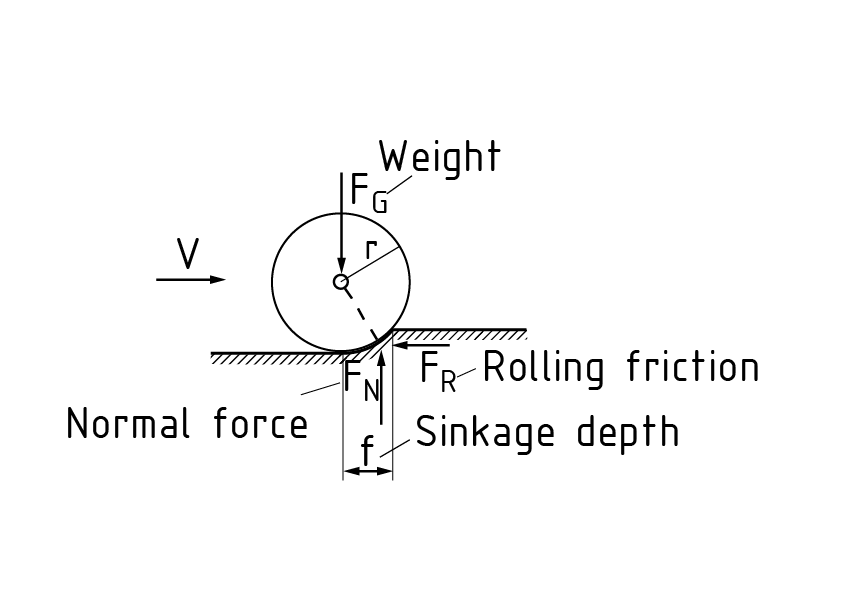
La fricción a la rodadura es una resistencia que resulta de la deformación que ocurre en un elemento que rueda (cilindro, bola, rueda) y la superficie sobre la que el elemento rueda. La fricción a la rodadura es por lo tanto también referida como resistencia a la rodadura. La resistencia de la fricción a la rodadura varía de acuerdo con los atributos de la superficie, el cumplimiento y la dureza del elemento de rodadura, y la superficie. Al igual que en el caso de los demás escenarios de fricción, hay un parámetro específico involucrado, en este caso el coeficiente de fricción a la rodadura ${{\mu }_{R}}$. Este parámetro puede ser determinado a partir de la siguiente relación: ${{\mu }_{R}}=f/r$, donde r es el radio de la bola y f es la profundidad de hundimiento. La profundidad de hundimiento se ilustra en la siguiente figura. También se conoce como el "brazo de palanca de la fricción a la rodadura". Fricción a la rodadura de un cilindro
resistencia a la tracción

滚动阻力