Gießen
Gießen ist ein Urformverfahren, bei dem Vor- und Zwischenprodukte (Halbzeuge) hergestellt werden, die beim Umformen weiterverarbeitet werden können. Unterschieden werden Gussverfahren in Dauerform und verlorener Form.
Gusswerkstoffe sind meist Eisen-Kohlenstoff-Verbindungen (Gusseisen, Stahl), Nichteisenmetalle wie Kupfer, Blei und Nickel, Leichtmetalle wie Aluminium oder Magnesium sowie Legierungen. Aber auch andere Werkstoffe (etwa Kunststoffe, Gips) werden gegossen.
Zu den Verfahren gehören etwa Blockgießverfahren in Dauerformen (Kokillen) oder Stranggießverfahren.
Zusammensetzung der Schmelze und Gefüge der Gussstücke, abhängig von Abkühlungsgeschwindigkeit, Keimbildung und Kristallwachstum, bestimmen die Eigenschaften der Gusstücke.
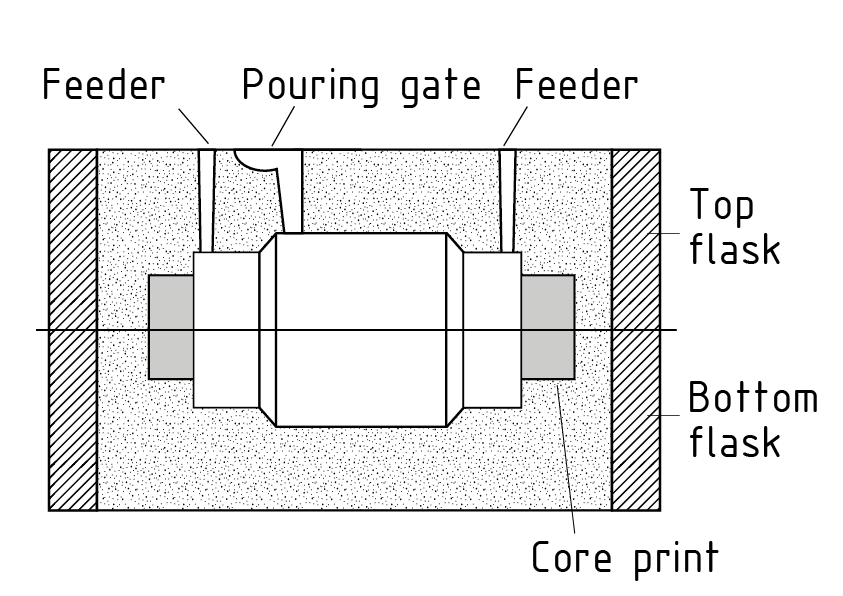
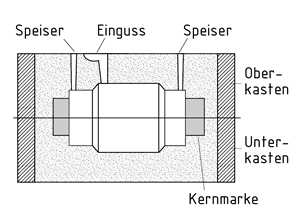
Nach dem Eingießen der Schmelze erstarrt diese geradwandig, rauwandig, schwammartig (exogene Erstarrung) oder schalenbildend (endogen) in der Form. Dabei verkleinert sich das Volumen des Gussstückes. Zur Kompensation werden Speiser eingesetzt.
-
Beispielsätze:
- Das Maschinengießen ist vor allem für Mittel- und Großfertigungen geeignet.
- Beim Spritzgießen und Kalandrieren werden Extruder als Plastifizier-Aggregate verwendet.
- An die Formstation schließen sich meist Fertigungsstationen zum Kerneinlegen, Gießen und Kühlen an.

cast
-
Example sentences:
- A distinction is made between casting in a permanent mould and expendable mould.
- The castings fall out of the mould once the vacuum is released.
- Afterwards, the shape and dimensions of the casting no longer resemble the original ingot.
- The smooth-running castors incorporate reliable braking mechanisms.
- The castors are on and the panel is being fitted now.
- Another option is to use a lockable container on castors.
casting
-
Example sentences:
- A distinction is made between casting in a permanent mould and expendable mould.
- The castings fall out of the mould once the vacuum is released.
- Afterwards, the shape and dimensions of the casting no longer resemble the original ingot.
pour
-
Example sentences:
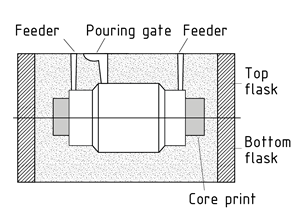
- In the case of vacuum forming, a vacuum is used to deep draw a film over the model for a one-off (expendable) mould and a pouring basin and feeder are formed.
- The electrons penetrate deeply into the material, creating a narrow, tubular vapour channel.
- Light effect - electric current causes certain gases (neon, argon, mercury vapour) to light up.
- Once the melt has been poured into the mould, solidification can be straight-walled, rough-walled and sponge-like (exogenous solidification) or shell-forming (endogenous).
pouring
-
Example sentences:
- In the case of vacuum forming, a vacuum is used to deep draw a film over the model for a one-off (expendable) mould and a pouring basin and feeder are formed.

Fundición
La fundición es un proceso de conformado que se usa para producir productos primarios e intermedios (productos semiterminados), que pueden ser procesados posteriormente mediante la conformado. Se debe distinguir entre la fundición en un molde permanente y un molde reemplazable.
Los materiales de fundición son usualmente compuestos de hierro-carbono (hierro fundido, acero), metales no ferrosos como el cobre, el plomo y el níquel, metales ligeros como el aluminio y el magnesio, o aleaciones. También se pueden fundir otros materiales (por ejemplo, plásticos y yeso).
Los procesos incluyen, por ejemplo, la fundición de lingotes en moldes permanentes y la fundición continua.
Las propiedades de la fundición son determinadas por la composición de la fundición y la estructura de la fundición, en combinación con la tasa de enfriamiento, la nucleación y el crecimiento de cristal.
Una vez que el material fundido se vierte en el molde, la solidificación puede ser de pared recta, de pared áspera y tipo esponja (solidificación exógena) o formadora de coraza (endógena). El volumen de la fundición se reduce durante este proceso. Se agregan alimentadores para compensar.
Fundición de molde reemplazable
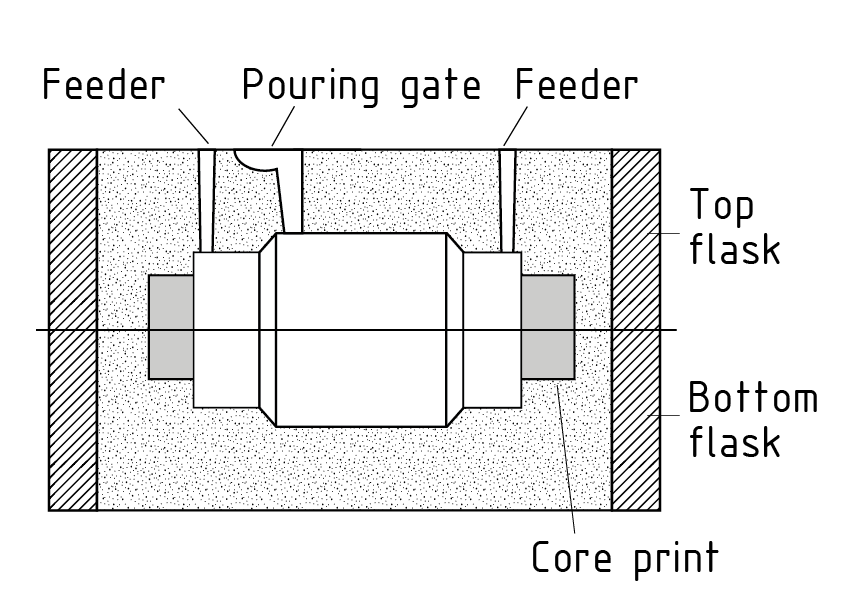
Fundición
La fundición es un proceso de conformado que se usa para producir productos primarios e intermedios (productos semiterminados), que pueden ser procesados posteriormente mediante la conformado. Se debe distinguir entre la fundición en un molde permanente y un molde reemplazable.
Los materiales de fundición son usualmente compuestos de hierro-carbono (hierro fundido, acero), metales no ferrosos como el cobre, el plomo y el níquel, metales ligeros como el aluminio y el magnesio, o aleaciones. También se pueden fundir otros materiales (por ejemplo, plásticos y yeso).
Los procesos incluyen, por ejemplo, la fundición de lingotes en moldes permanentes y la fundición continua.
Las propiedades de la fundición son determinadas por la composición de la fundición y la estructura de la fundición, en combinación con la tasa de enfriamiento, la nucleación y el crecimiento de cristal.
Una vez que el material fundido se vierte en el molde, la solidificación puede ser de pared recta, de pared áspera y tipo esponja (solidificación exógena) o formadora de coraza (endógena). El volumen de la fundición se reduce durante este proceso. Se agregan alimentadores para compensar.
Fundición de molde reemplazable
vaciado
vaciar

浇铸
铸造