
Wechsel (mech.)

alternating stress
Description:
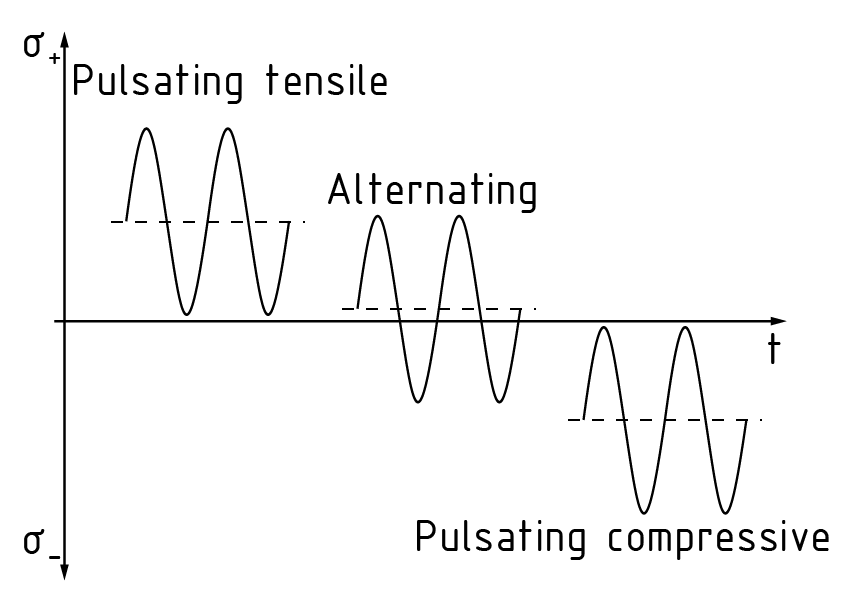
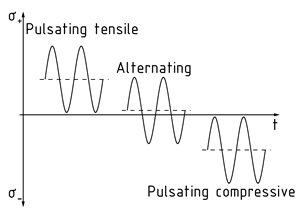
In the case of alternating stress, cyclic forces act on a component with a change of direction. This is the situation when the maximum stress${{\sigma }_{o}}$ is in the opposite direction to the minimum stress${{\sigma }_{u}}$. Dividing the minimum stress by the maximum stress gives the stress ratio $R=\frac{{{\sigma }_{u}}}{{{\sigma }_{o}}}$. The mean stress ${{\sigma }_{m}}$is the average stress calculated using the maximum and minimum values. Based on this, a distinction is made between the following scenarios: ${{\sigma }_{m}}0:$ If the maximum and minimum stresses act in opposite directions and are not equal, the result is an alternating stress. If the minimum stress equals zero and the maximum stress is positive, the result is a pure pulsating tensile stress. If the maximum and minimum stresses are both positive, the result is a pulsating tensile stress.
-
Example sentences:
- In the case of alternating stress, vibratory forces act on a component with a change of direction.
- If the maximum and minimum stresses act in opposite directions and are not equal, the result is an alternating stress.
- If the maximum and minimum stresses act in opposite directions and are not equal, the result is an alternating stress.

esfuerzo alternante
Description:
En el caso de un esfuerzo alternante, las fuerzas cíclicas actúan en un componente con un cambio de dirección. Esta es la situación cuando el esfuerzo máximo ${{\sigma }_{o}}$ está en la dirección opuesta al esfuerzo mínimo ${{\sigma }_{u}}$ . Dividir el esfuerzo mínimo por el esfuerzo máximo da como resultado la relación de esfuerzos $R=\frac{{{\sigma }_{u}}}{{{\sigma }_{o}}}$ . El esfuerzo medio ${{\sigma }_{m}}$ es el esfuerzo promedio calculado usando los valores mínimos y máximos. Basado en esto, se distingue entre los siguientes escenarios: ${{\sigma }_{m}}0$ : Si los esfuerzos mínimos y máximos actúan en direcciones opuestas y no son iguales, el resultado es un esfuerzo alternante. Si el esfuerzo mínimo es igual a cero y el esfuerzo máximo es positivo, el resultado es un esfuerzo de tensión pulsante puro. Si los esfuerzos máximos y mínimos son ambos positivos, el resultado es un esfuerzo de tensión pulsante. Perfil de esfuerzo para un esfuerzo alternante/pulsante

交变应力
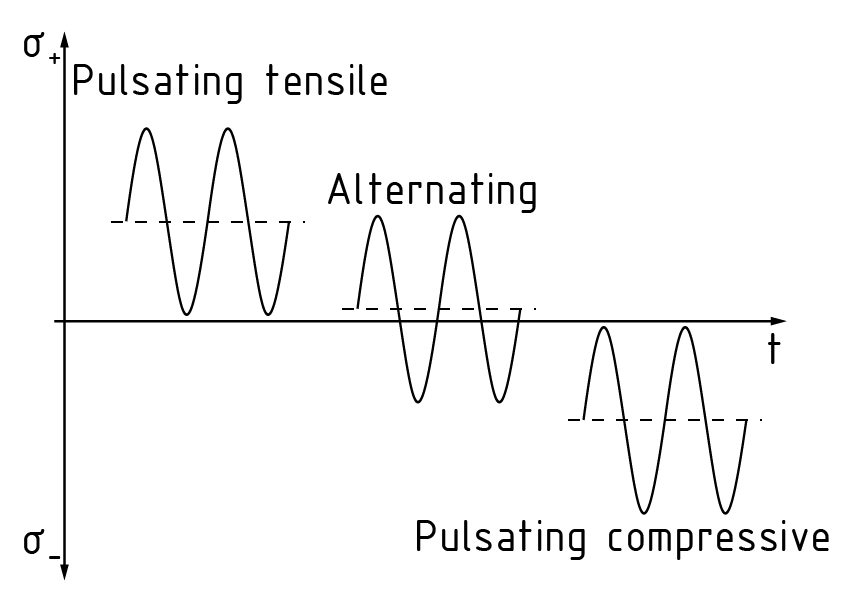
Description:
在交变应力情况下,构件上的应力随时间周期性变化,且应力的方向随时间交替变化。最大应力 ${{\sigma }_{o}}$ 与最小应力 ${{\sigma }_{u}}$ 的方向彼此相反。 最小应力与最大应力之比可以得出交变应力的循环特征 $R=\frac{{{\sigma }_{u}}}{{{\sigma }_{o}}}$ 。平均应力 ${{\sigma }_{m}}$ 是最大应力和最小应力的平均值。根据上述定义,下列不同条件下力的效果不同: ${{\sigma }_{m}}0$ : 如果最大应力和最小应力方向相反且大小不等,则力的效果为交变应力。 如果最小应力等于零而最大应力为正方向,则力的效果为纯脉动拉伸应力。 如果最大应力和最小应力都为正方向,则力的效果为脉动拉伸应力。 交变应力/脉动应力的应力图