

Stärke
-
Beispielsätze:
- Sie können Flächenelemente mit einer Stärke von 4 bis 5 mm aufnehmen.
- Sie sind über Langlöcher an die Stärke des Flächenelementes anpassbar.
- Die Stärke der Geräuschimmission hängt von der Entfernung zur Schallquelle ab.

intensity
Description:
The intensity of a noise immission depends on the distance from the sound source. The parameter for fracture toughness is the critical stress intensity factorKIc. The sound level is often described colloquially as the volume or noise intensity.
-
Example sentences:
- The intensity of a noise immission depends on the distance from the sound source.
- The parameter for fracture toughness is the critical stress intensity factorKIc.
- The sound level is often described colloquially as the volume or noise intensity.
power
Description:
Power is the Work $\Delta W$ and/or energy $\Delta E$ that is implemented over a specific period of time $\Delta t$. Power P is measured in $Nm/s$ or W (watts). It is important in both Mechanics and as electrical power. It is calculated using the formula $P(t)=\frac{\Delta W}{\Delta t}$ or $P(t)=\frac{dW}{dt}$. In the case of a translational movement, power P is the product of the Force vector $\overrightarrow{F}$ and the Velocity vector $\overrightarrow{v}$ that is acting in the same direction. In the case of a Rotation, it is the product of angular velocity $\overrightarrow{\omega }$ and moment $\overrightarrow{M}$. In hydraulics, power is obtained by multiplying the volumetric flow rate Q by pressure p.
-
Example sentences:
- Always disconnect the Light Fitting from its power source before conducting any maintenance or repair work.
- One wheel is powered and is also used for steering and braking.
- Luminous flux describes the power of a light source.
strength
Description:
A material's strength is the maximum stress to which a given cross-section of that Material can be subjected. It therefore indicates the material's Resistance to deformation. A maximum Force on the material's non-deformed cross-sectional area for a specific elongation or specific flow characteristics is used to define the strength. Strength values are not the stresses that actually occur. In most cases, they are calculated from the nominal stresses, i.e. from the test force and the cross-sections prior to the start of the test. Different strengths are defined depending on the type of stress. They include: Tensile strength Compressive strength Bulk strength Buckling strength Torsional strength Shear strength A further distinction is made according to whether the stress is uniaxial or multiaxial and whether a static or dynamic stress is applied to the component. This results in a differentiation between e.g.: Static strength Increasing strength Finite-life fatigue strength Fatigue limit Fatigue strength
-
Example sentences:
- Its high tensile strength offers additional security against rupture.
- The dual screw connection provides additional strength.
- A person's physical strength will also vary according to their age, body size, weight and gender.

energía
fuerza
Description:
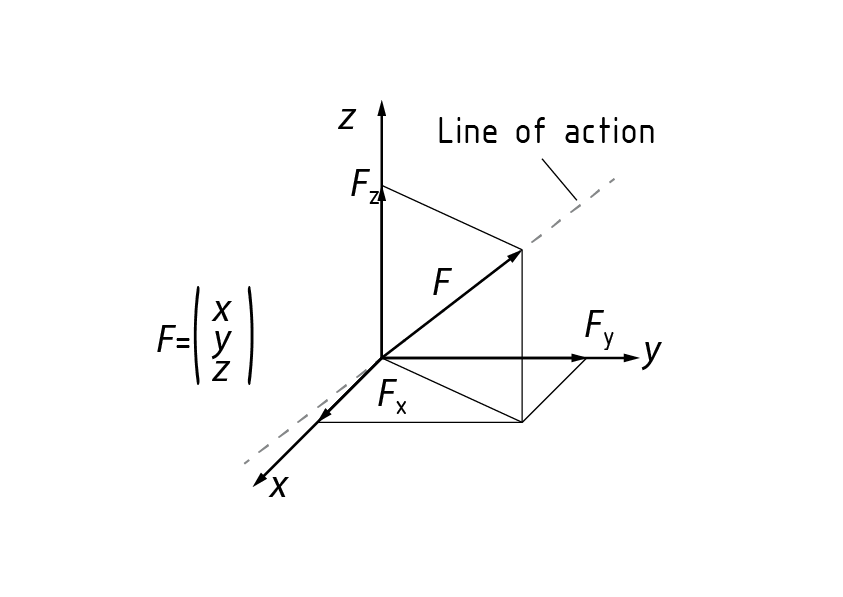
Una fuerza F genera un cambio de movimiento o cambio de forma. La unidad de medición para la fuerza es el newton N, que está compuesto de las siguientes unidades: kilogramos, metros, segundos al cuadrado $kg?m?s^{-2} $. Se puede representar como una cantidad de vector basada en su magnitud, dirección y ubicación. Este vector de fuerza se puede mover libremente a lo largo de su línea de acción. En un espacio tridimensional, la fuerza se describe con los componentes $F_{X}$ , $F_{Y}$ y $F_{Z}$ , donde que cada uno representa una dimensión diferente. Cuando una fuerza actúa en un cuerpo mediante un brazo de palanca, se genera un momento y el cuerpo es rotado. Un desglose de los componentes en un vector de fuerza F
intensidad

强度
Description:
一种材料的强度是指该材料的给定横截面能够承受的最大应力。因此它可以表示材料的抗变形力。在特定伸长率或特定流动特性范围内,材料未变形横截面面积上能够承受的最大力就是材料的强度。强度值不是实际产生的应力。在大多数情况下,通过公称应力计算强度,即通过试验中施加的力和试验开始前的横截面来计算。 根据应力的类型,强度可分为: 拉伸强度 压缩强度 整体强度 压曲强度 扭转强度 剪切强度 还可以根据施加在构件上的应力是单轴或多轴、静态或动态,而将强度以此分为: 静强度 增量强度 有限寿命疲劳强度 疲劳极限 疲劳强度