

statische Festigkeit
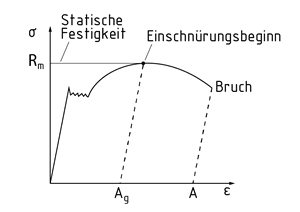
Die statische Festigkeit ${{R}_{m}}$ beschreibt eine Spannung, die der Verformung eines Bauteils aufgrund einer wirkenden statischen Kraft entgegenwirkt. Die statische Festigkeit ist werkstoffabhängig und als ein Widerstand gegen eine Verformung zu verstehen.
Durch den Zugversuch wird die statische Festigkeit experimentell ermittelt. Bei Überschreitung der statischen Festigkeit schürt die Zugprobe ein. In einem Spannungs-Dehnungsdiagramm ist ${{R}_{m}}$ die maximal wirkende Spannung.
Die Gleichmaßdehnung ${{A}_{g}}$ beschreibt den Zustand einer Zugprobe, die sich gerade noch gleichmäßig dehnt. Bei ${{A}_{g}}$ist die statische Festigkeit erreicht.
Die bleibende Verlängerung der Probe bei einem Bruch ist die Bruchdehnung $A$.
-
Beispielsätze:
- Durch den Zugversuch wird die statische Festigkeit experimentell ermittelt.
- Die statische Festigkeit ist werkstoffabhängig und als ein Widerstand gegen eine Verformung zu verstehen.
- Das Einspannen des Flächenlementes im Profilrahmen bewirkt eine erhöhte statische Festigkeit bei gleichzeitig geringerem Materialgewicht.

rigidity
-
Example sentences:
- A material's rigidity can be indicated by the modulus of elasticity.
- High rigidity and long service life combine with minimum maintenance.
- Compound Material has good shear rigidity, flexural strength and buckling strength.
static strength
-
Example sentences:
- Exceeding the static strength causes necking of the tensile test specimen.
- The tensile test is used to determine the static strength in experiments.
- This dynamic strength is roughly equivalent to a component's static strength.
Static tensile strength
Static tensile Strength ${{R}_{m}}$ is a tension that counteracts the deformation of a component based on an active static Force. The static tensile strength depends on the Material and should be understood as Resistance to deformation.
The tensile test is used as an experimental means of determining static tensile strength. Exceeding the static tensile strength causes necking of the tensile test specimen. In a stress-strain diagram, ${{R}_{m}}$ is the maximum active tension.
Uniform elongation ${{A}_{g}}$ is when a tensile test specimen manages to stretch evenly. The static tensile strength is reached at ${{A}_{g}}$.
The specimen's permanent elongation at the point of rupture is called the elongation at rupture $A$.
Static tensile strength
Static tensile Strength ${{R}_{m}}$ is a tension that counteracts the deformation of a component based on an active static Force. The static tensile strength depends on the Material and should be understood as Resistance to deformation.
The tensile test is used as an experimental means of determining static tensile strength. Exceeding the static tensile strength causes necking of the tensile test specimen. In a stress-strain diagram, ${{R}_{m}}$ is the maximum active tension.
Uniform elongation ${{A}_{g}}$ is when a tensile test specimen manages to stretch evenly. The static tensile strength is reached at ${{A}_{g}}$.
The specimen's permanent elongation at the point of rupture is called the elongation at rupture $A$.

Resistencia a la tensión estática
La resistencia a la tensión estática ${{R}_{m}}$ es una tensión que contrarresta la deformación de un componente basado en una fuerza estática activa. La resistencia a la tensión estática depende del material y debe comprenderse como una resistencia a la deformación.
La prueba de tensión se usa como un medio experimental para determinar la resistencia a la tensión estática. Exceder la resistencia a la tensión estática causa la estricción del espécimen de la prueba de tensión. En un diagrama de esfuerzo-deformación, ${{R}_{m}}$ es la tensión activa máxima.
La elongación uniforme ${{A}_{g}}$ es cuando el espécimen de la prueba de tensión logra estirarse de manera pareja. La resistencia a tensión estática se alcanza a ${{A}_{g}}$.
La elongación permanente del espécimen en el punto de ruptura se llama elongación en la ruptura $A$.
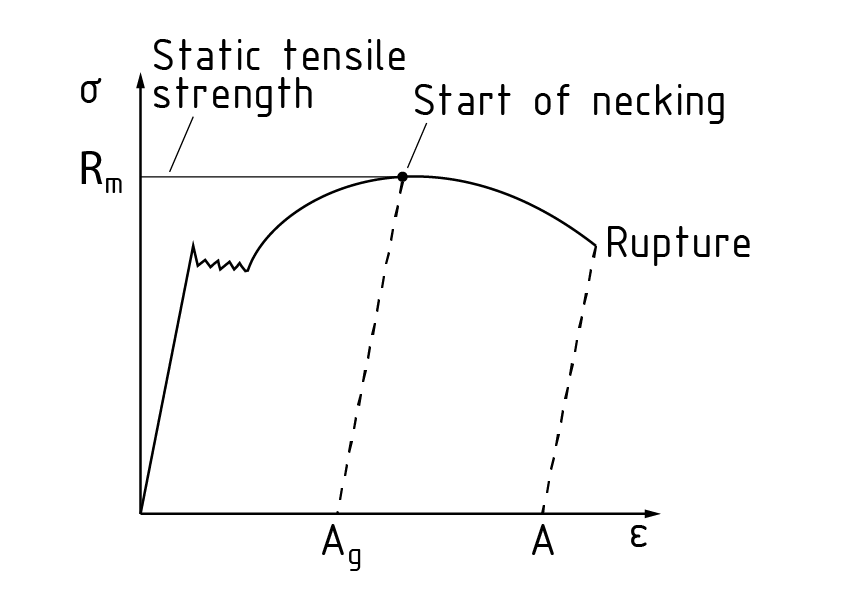
Resistencia a la tensión estática en un diagrama esfuerzo-deformación
Resistencia a la tensión estática
La resistencia a la tensión estática ${{R}_{m}}$ es una tensión que contrarresta la deformación de un componente basado en una fuerza estática activa. La resistencia a la tensión estática depende del material y debe comprenderse como una resistencia a la deformación.
La prueba de tensión se usa como un medio experimental para determinar la resistencia a la tensión estática. Exceder la resistencia a la tensión estática causa la estricción del espécimen de la prueba de tensión. En un diagrama de esfuerzo-deformación, ${{R}_{m}}$ es la tensión activa máxima.
La elongación uniforme ${{A}_{g}}$ es cuando el espécimen de la prueba de tensión logra estirarse de manera pareja. La resistencia a tensión estática se alcanza a ${{A}_{g}}$.
La elongación permanente del espécimen en el punto de ruptura se llama elongación en la ruptura $A$.
Resistencia a la tensión estática en un diagrama esfuerzo-deformación
resistencia estática
rigidez

刚性
静拉伸强度
静拉伸强度 ${{R}_{m}}$ 是外部静力作用下构件抵抗变形产生的张力。静拉伸强度取决于材料,是一种抵抗力。
拉伸试验是用来确定静拉伸强度的实验手段。超过静拉伸强度会导致拉伸试验样品出现缩颈现象。在应力-应变曲线中, ${{R}_{m}}$ 为最大拉伸力。
均匀伸长 ${{A}_{g}}$ 是指拉伸试验样品匀速伸长。在 ${{A}_{g}}$ 点达到静拉伸强度。
样品在断裂点处的永久伸长被称为断裂伸长 $A$ 。
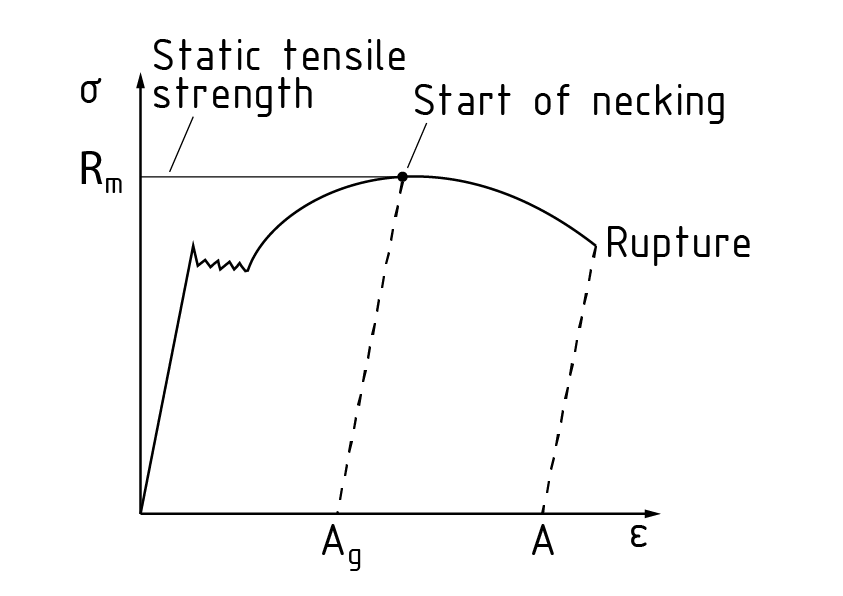
应力-应变曲线中的静拉伸强度
静拉伸强度
静拉伸强度 ${{R}_{m}}$ 是外部静力作用下构件抵抗变形产生的张力。静拉伸强度取决于材料,是一种抵抗力。
拉伸试验是用来确定静拉伸强度的实验手段。超过静拉伸强度会导致拉伸试验样品出现缩颈现象。在应力-应变曲线中, ${{R}_{m}}$ 为最大拉伸力。
均匀伸长 ${{A}_{g}}$ 是指拉伸试验样品匀速伸长。在 ${{A}_{g}}$ 点达到静拉伸强度。
样品在断裂点处的永久伸长被称为断裂伸长 $A$ 。
应力-应变曲线中的静拉伸强度