
Deutsch

Thyristor (Masculine)

Beschreibung:

Thyristoren sind schaltbare Halbleiterventile. In der Leistungselektronik werden Thyristoren vor allem zur Steuerung elektrischer Antriebe genutzt. Thyristoren kommen dann zum Einsatz, wenn hohe Schaltleistungen (bis ca. 100.000 kVA) bei niedrigen Frequenzen benötigt werden.

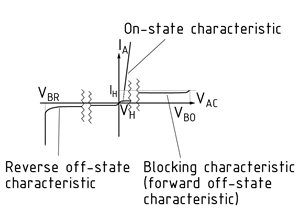
In positiv angesteuerter Richtung ergeben sich zwei Kennlinien: die sogenannte Blockierkennlinie und die Durchlasskennlinie. Bei angelegter Kathoden-Anoden-Spannung ${U_{AK}}$ (ohne Gate-Signal) geht der Thyristor zunächst auf die Blockierkennlinie. Sobald ein ausreichend positives Signal am Gate anliegt, wechselt der Thyristor schlagartig auf die Durchlasskennline und bleibt auf ihr, solange der Haltestrom ${I_H}$ fließt. Unterschreitet man den Haltestrom, springt der Thyristor vom Ast der Durchlasskennline auf den Ast der Blockierkennlinie. Erhöht man bei einem blockierten Thyristor die Spannung${U_{AK}}$über den zulässigen Höchstwert, so findet ebenfalls eine Zündung statt$({U_{B0}})$. Für diese 'Überkopfzündung' ist das Bauelement jedoch nicht ausgelegt und sie kann zur Zerstörung führen.

Die Rückwärts-Sperrkennlinie entspricht im Wesentlichen der einer Diode. Auch hier ist darauf zu achten, die Durchbruchspannung${U_{BR}}$ nicht zu überschreiten.
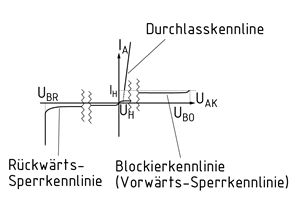
Ausgangskennlinien des Thyristors
    Beispielsätze:
  • Charakterisierend für den Abschaltvorgang beim GTO-Thyristor ist der Schweifstrom (auch Tailstrom).
  • The tail current is a characteristic feature of the switching-off process with GTO thyristors.
  • In der Leistungselektronik werden Thyristoren vor allem zur Steuerung elektrischer Antriebe genutzt.

English

SCR (Neuter)

Description: The tightening torque for the tensioning screw must not exceed 3 Nm. Tighten the right and left adjusting screws alternately. The dual screw connection provides additional strength.
    Example sentences:
  • The tightening torque for the tensioning screw must not exceed 3 Nm.
  • Tighten the right and left adjusting screws alternately.
  • The dual screw connection provides additional strength.
English

silicon-controlled rectifier (Neuter)

English

thyristor (Neuter)

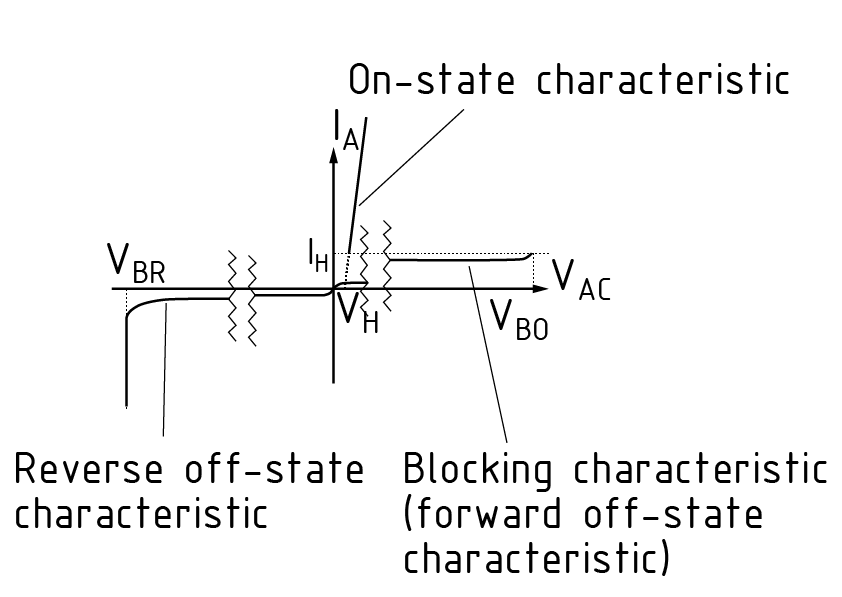
Description: Thyristors are switchable semi-Conductor valves. In Power electronics, thyristors are primarily used to control electric drives. They are utilised when high switching capacities (up to approx. 100,000 kVA) are needed at low frequencies. In the positive control direction, there are two characteristic curves - the blocking characteristic and the on-state characteristic. When a cathode-anode voltage ${U_{AC}}$ (without gate signal) is applied, the thyristor first goes to the blocking characteristic. As soon as the gate signal is sufficiently positive, the thyristor instantly switches to the on-state characteristic and remains there as long as the holding current ${I_H}$ is flowing. Failure to reach the holding current causes the thyristor to jump from the branch of the on-state characteristic to that of the blocking characteristic. Increasing the voltage ${V_{AC}}$above the permissible maximum value with a blocked thyristor also causes ignition $({{\rm{V}}_{B0}})$. However, the component is not designed for this type of ignition and may be destroyed. The reverse off-state characteristic is essentially the same as that of a Diode. Here, too, care needs to be taken not to exceed the breakdown voltage ${V_{BR}}$.
Thyristor's output characteristics
Spanisch

rectificador controlado por silicio (Neuter)

Spanisch

tiristor (Neuter)

Description: Los tiristores son válvulas semiconductoras conmutables. En electrónica de potencia, los tiristores se usan principalmente para controlar accionamientos eléctricos. Se usan cuando se requieren altas capacidades conmutables (de hasta aprox.100,000 kVA) a bajas frecuencias. En la dirección de control positiva, hay dos curvas características: la característica de bloqueo y la característica de modo activo. Cuando se aplica un voltaje cátodo-ánodo ${U_{AC}}$ (sin señal de compuerta), el tiristor pasa primero a la característica de bloqueo. En cuanto la señal de compuerta es lo suficientemente positiva, el tiristor cambia instantáneamente a la característica de modo activo y permanece así mientras la corriente de retención ${I_H}$ esté fluyendo. Si no se alcanza la corriente de retención, el tiristor saltará de la rama de la característica de modo activo a la de la característica de bloqueo. El incremento del voltaje ${V_{AC}}$ por encima del valor máximo permisible con un tiristor bloqueado también causa ignición $({{\rm{V}}_{B0}})$ . Sin embargo, el componente no está diseñado para este tipo de ignición y puede destruirse. La característica de modo inactivo inversa es básicamente la misma que la de un diodo. Aquí, también, se debe tener cuidado de no exceder el voltaje de descomposición ${V_{BR}}$ . Características de salida del tiristor
Características de salida del tiristor
Chinesisch

可控硅整流器 (Neuter)

Chinesisch

晶闸管 (Neuter)