

Arbeitsplatzsysteme
Beschreibung:
Definition
Was sind Arbeitsplatzsysteme?
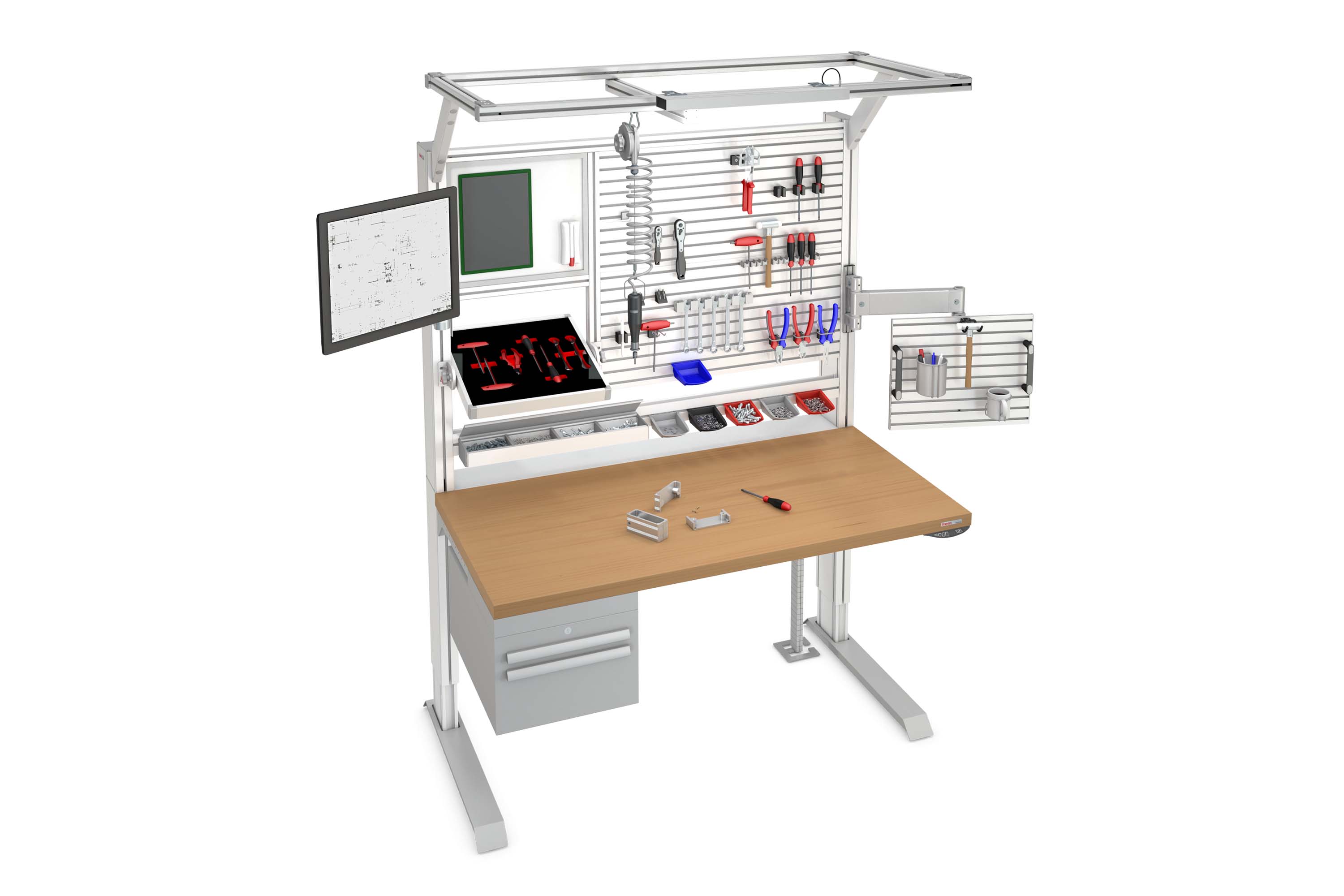
Arbeitsplatzsysteme sind aufeinander abgestimmte Systeme aus standardisierten Komponenten wie z. B. Aluminiumprofilen, Tischen, Stühlen, Zubehör und Erweiterungskomponenten, mit denen sich anwendungsspezifische Industriearbeitsplätze flexibel gestalten lassen. Ein Arbeitsplatzsystem bildet die strukturelle und funktionale Grundlage für manuelle Tätigkeiten in der Produktion.
Anders als ein Schreibtisch oder eine einzelne Werkbank umfasst ein Arbeitsplatzsystem alle Elemente, die Mitarbeitende benötigen, um ihre Aufgaben effizient, sicher und komfortabel ausführen zu können. Dazu gehören unter anderem die Arbeitsfläche, Beleuchtung sowie die Werkzeug- und Materiabereitstellung.
Das item Arbeitsplatzsystem ist ein Beispiel für ein solches modulares System: Es basiert auf einem durchgängigen Baukastenprinzip, das eine maximal flexible und ergonomische Arbeitsplatzgestaltung sowie individuelle Anpassbarkeit ermöglicht.
Anders als ein Schreibtisch oder eine einzelne Werkbank umfasst ein Arbeitsplatzsystem alle Elemente, die Mitarbeitende benötigen, um ihre Aufgaben effizient, sicher und komfortabel ausführen zu können. Dazu gehören unter anderem die Arbeitsfläche, Beleuchtung sowie die Werkzeug- und Materiabereitstellung.
Das item Arbeitsplatzsystem ist ein Beispiel für ein solches modulares System: Es basiert auf einem durchgängigen Baukastenprinzip, das eine maximal flexible und ergonomische Arbeitsplatzgestaltung sowie individuelle Anpassbarkeit ermöglicht.
Gut zu wissen
Was macht Arbeitsplatzsysteme in der Industrie aus?
Arbeitsplatzsysteme in der Industrie stechen durch ihr perfektes Zusammenspiel aus Ergonomie, Modularität, Prozesssicherheit und Effizienz hervor. So werden sowohl manuelle Prozesse in der Fertigung optimal unterstützt. Arbeitsplatzsysteme besitzen die Anpassungsfähigkeit an verschiedene Prozesse sowie an individuelle körperliche Voraussetzungen verschiedener Mitarbeitender.
Höhenverstellbare Tische, greifoptimierte Materialbereitstellung und anpassbare Beleuchtung schützen die Gesundheit der Mitarbeitenden und steigern gleichzeitig die Produktivität. Kurze Greifwege und strukturierte Ablagen, etwa nach dem FIFO-Prinzip, sowie die direkte Anbindung an Förderbänder oder Rollenbahnen vermeiden unnötige Wege und fördern die wertschöpfende Arbeit.
In der Industrie müssen Arbeitsplätze häufig schnell umgerüstet werden, etwa wenn ein neues Produkt eingeführt wird oder sich die Produktionsabläufe ändern. Durch ein Baukastenprinzip lassen sich Arbeitstische, Regale und Halterungen schnell erweitern und an neue Produkte sowie Abläufe anpassen. Entscheidend ist dabei, dass die Umrüstung keine Kompromisse bei Ergonomie und Sicherheit bedeutet. Daher lassen industrielle Arbeitsplatzsysteme die Ausstattung der Arbeitstische mit ableitfähigen Komponenten zu, um sensible Elektronik vor elektrostatischer Entladung (ESD) zu schützen.
Höhenverstellbare Tische, greifoptimierte Materialbereitstellung und anpassbare Beleuchtung schützen die Gesundheit der Mitarbeitenden und steigern gleichzeitig die Produktivität. Kurze Greifwege und strukturierte Ablagen, etwa nach dem FIFO-Prinzip, sowie die direkte Anbindung an Förderbänder oder Rollenbahnen vermeiden unnötige Wege und fördern die wertschöpfende Arbeit.
In der Industrie müssen Arbeitsplätze häufig schnell umgerüstet werden, etwa wenn ein neues Produkt eingeführt wird oder sich die Produktionsabläufe ändern. Durch ein Baukastenprinzip lassen sich Arbeitstische, Regale und Halterungen schnell erweitern und an neue Produkte sowie Abläufe anpassen. Entscheidend ist dabei, dass die Umrüstung keine Kompromisse bei Ergonomie und Sicherheit bedeutet. Daher lassen industrielle Arbeitsplatzsysteme die Ausstattung der Arbeitstische mit ableitfähigen Komponenten zu, um sensible Elektronik vor elektrostatischer Entladung (ESD) zu schützen.
Welche Komponenten gehören zu industriellen Arbeitsplatzsystem?
Industrielle Arbeitsplatzsysteme, wie z.B. das item Arbeitsplatzsystem, bestehen aus mehreren aufeinander abgestimmten Komponenten:
Arbeitstisch: Dieser bildet die Basis und sollte danach ausgewählt werden, welche Lasten bearbeitet werden. Idealerweise sollte er höhenverstellbar sein, um ihn an verschiedene Körpergrößen und Arbeitshaltungen anpassen zu können.
Arbeitsstuhl: Jeder Arbeitsplatz wird durch einen ergonomischen Arbeitsstuhl ergänzt. Dieser unterstützt durch eine individuell einstellbare Rückenlehne eine gesunde Körperhaltung und ermöglicht zudem dynamisches Sitzen (häufiger Wechsel von Position und Haltung).
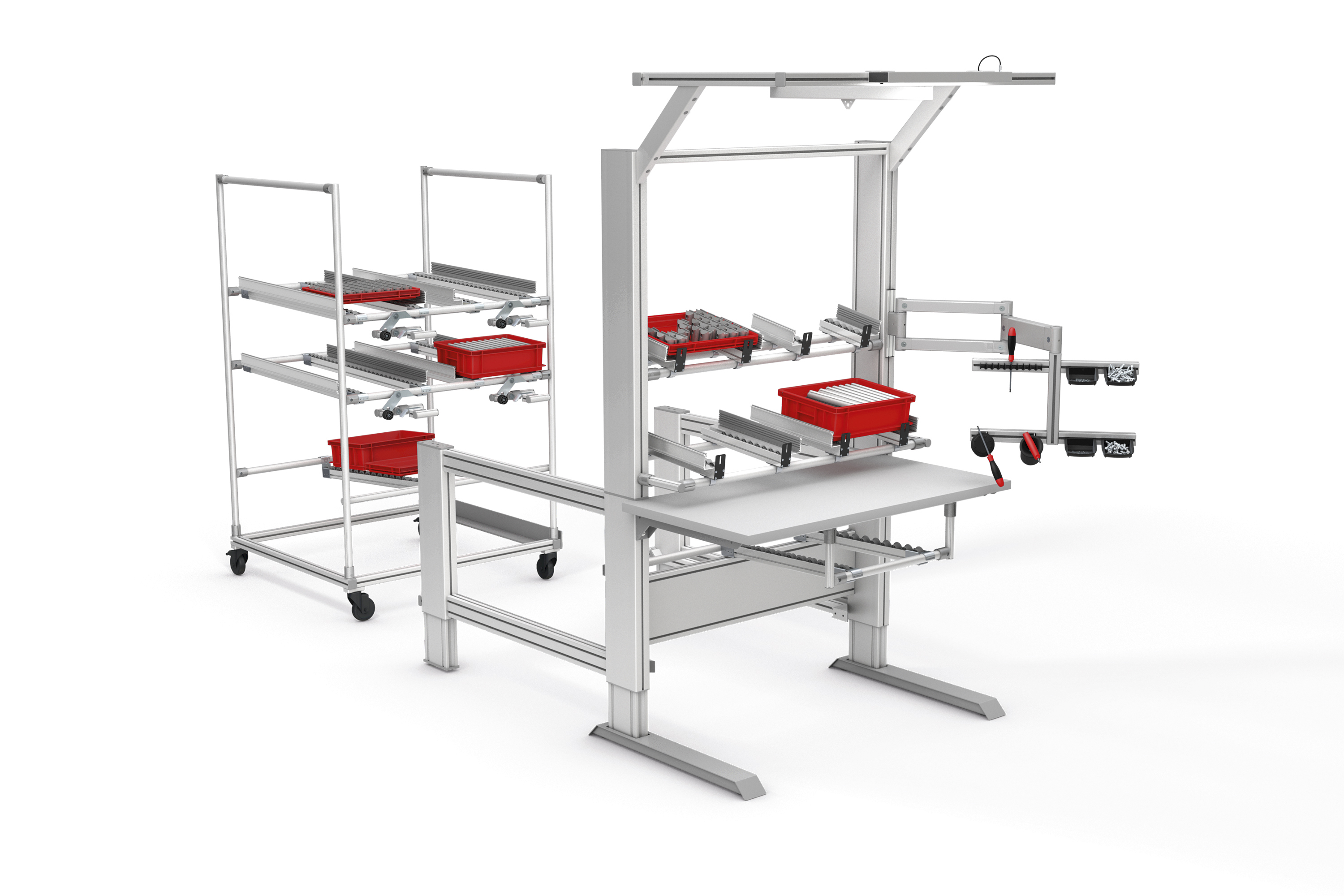
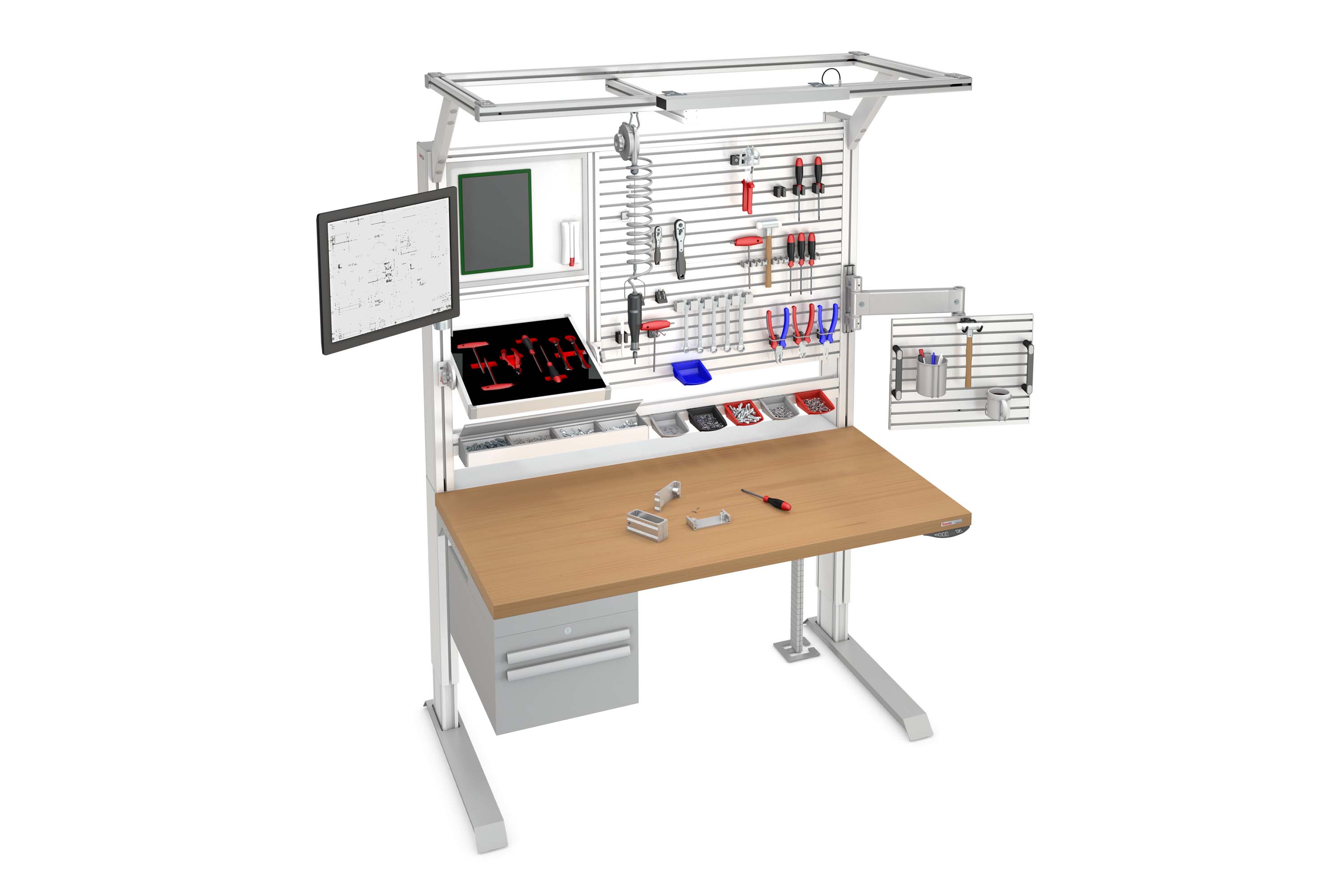
Werkzeug- und Materialbereitstellung: Hierfür kommen Schwenkarme, Greifschalen, Schubladen sowie Werkzeugwände wie das item toolpanel® und Materialwagen verschiedener Art zum Einsatz.
Beleuchtung: Die Beleuchtung am Arbeitsplatz sollte für eine blendfreie, schattenarme Ausleuchtung des Arbeitsbereichs sorgen. Neutralweißes LED-Licht bei ca. 4.000 Kelvin ist dafür ideal. Welche Faktoren die Beleuchtung beeinflussen, können Sie in diesem kostenfreien Factsheet nachlesen.
Medienversorgung: Ein Arbeitsplatz in der Industrie muss mit Strom, Druckluft und Daten versorgt werden sowie mit Elementen zur Informationsbereitstellung wie Vorlagenhalter, Schwenkarme oder Magnettafeln ausgestattet sein.
Arbeitstisch: Dieser bildet die Basis und sollte danach ausgewählt werden, welche Lasten bearbeitet werden. Idealerweise sollte er höhenverstellbar sein, um ihn an verschiedene Körpergrößen und Arbeitshaltungen anpassen zu können.
Arbeitsstuhl: Jeder Arbeitsplatz wird durch einen ergonomischen Arbeitsstuhl ergänzt. Dieser unterstützt durch eine individuell einstellbare Rückenlehne eine gesunde Körperhaltung und ermöglicht zudem dynamisches Sitzen (häufiger Wechsel von Position und Haltung).
Werkzeug- und Materialbereitstellung: Hierfür kommen Schwenkarme, Greifschalen, Schubladen sowie Werkzeugwände wie das item toolpanel® und Materialwagen verschiedener Art zum Einsatz.
Beleuchtung: Die Beleuchtung am Arbeitsplatz sollte für eine blendfreie, schattenarme Ausleuchtung des Arbeitsbereichs sorgen. Neutralweißes LED-Licht bei ca. 4.000 Kelvin ist dafür ideal. Welche Faktoren die Beleuchtung beeinflussen, können Sie in diesem kostenfreien Factsheet nachlesen.
Medienversorgung: Ein Arbeitsplatz in der Industrie muss mit Strom, Druckluft und Daten versorgt werden sowie mit Elementen zur Informationsbereitstellung wie Vorlagenhalter, Schwenkarme oder Magnettafeln ausgestattet sein.
Welche Vorteile haben modulare Arbeitsplatzsysteme?
Modulare Arbeitsplatzsysteme haben durch ihre maximale Flexibilität einen großen Vorteil: Dank der Modularität lassen sich Komponenten jederzeit hinzufügen, austauschen oder umpositionieren, ohne den kompletten Arbeitsplatz ersetzen zu müssen. Das spart langfristig Kosten und ermöglicht eine schnelle Reaktion auf wechselnde Produktionsanforderungen.
Gleichzeitig können modulare Arbeitsplatzsysteme optimal auf individuelle körperliche Voraussetzungen der Mitarbeitenden abgestimmt werden. Eine angenehme und zugleich logische Anordnung von Werkzeugen und Material schont die Körperhaltung, verkürzt Zugriffszeiten und optimiert Arbeitsprozesse. Darüber hinaus lassen sich modulare Lösungen nahtlos in den innerbetrieblichen Materialfluss integrieren, beispielsweise durch die Anbindung an Förderbänder sowie Rollenbahnen.
Das item Arbeitsplatzsystem setzt dieses Prinzip konsequent um: Alle Komponenten sind aufeinander abgestimmt und lassen sich online für individuelle Anforderungen zusammenstellen.
Gleichzeitig können modulare Arbeitsplatzsysteme optimal auf individuelle körperliche Voraussetzungen der Mitarbeitenden abgestimmt werden. Eine angenehme und zugleich logische Anordnung von Werkzeugen und Material schont die Körperhaltung, verkürzt Zugriffszeiten und optimiert Arbeitsprozesse. Darüber hinaus lassen sich modulare Lösungen nahtlos in den innerbetrieblichen Materialfluss integrieren, beispielsweise durch die Anbindung an Förderbänder sowie Rollenbahnen.
Das item Arbeitsplatzsystem setzt dieses Prinzip konsequent um: Alle Komponenten sind aufeinander abgestimmt und lassen sich online für individuelle Anforderungen zusammenstellen.
Was ist der Unterschied zwischen herkömmlichen und ergonomischen Arbeitsplatzsystemen?
Im Gegensatz zu herkömmlichen Arbeitsplatzsystemen passen ergonomische Arbeitsplatzsysteme die Betriebsmittel an die individuellen körperlichen Bedürfnisse der Mitarbeitenden an. Die flexible Höhenverstellung ermöglicht einen einfachen Wechsel zwischen Sitz- und Stehposition und fördert so Bewegung im Arbeitsalltag. Das regt den Kreislauf an, steigert das Wohlbefinden und unterstützt die Konzentration.
Der Seh- und Greifraum lässt sich ebenfalls bei ergonomischen Arbeitsplatzsystemen wie dem item Arbeitsplatzsystem individuell anpassen, etwa durch verschiedene Arten der Materialbereitstellung und eine individuelle Beleuchtung. So werden natürliche Bewegungsabläufe gefördert und belastende Körperhaltungen und damit einhergehende Schmerzen sowie Verspannungen reduziert. Ergonomie zielt dabei nicht nur auf die Vermeidung von Arbeitsunfällen ab. Sie soll außerdem Mitarbeitende gezielt schonen, damit sie möglichst lange gesund, motiviert und leistungsfähig bleiben. Wie ein optimaler Seh- und Greifraum aufgebaut sein sollte, erfahren Sie im kostenfreien Factsheet.
Der Seh- und Greifraum lässt sich ebenfalls bei ergonomischen Arbeitsplatzsystemen wie dem item Arbeitsplatzsystem individuell anpassen, etwa durch verschiedene Arten der Materialbereitstellung und eine individuelle Beleuchtung. So werden natürliche Bewegungsabläufe gefördert und belastende Körperhaltungen und damit einhergehende Schmerzen sowie Verspannungen reduziert. Ergonomie zielt dabei nicht nur auf die Vermeidung von Arbeitsunfällen ab. Sie soll außerdem Mitarbeitende gezielt schonen, damit sie möglichst lange gesund, motiviert und leistungsfähig bleiben. Wie ein optimaler Seh- und Greifraum aufgebaut sein sollte, erfahren Sie im kostenfreien Factsheet.
Wie können Arbeitsplatzsysteme in der Produktion eingesetzt werden?
Industrielle Arbeitsplatzsysteme decken ein breites Spektrum an Einsatzmöglichkeiten ab. Mit dem item Arbeitsplatzsystem lassen sich z. B. Arbeitsplätze für die Einzelmontage realisieren, an denen Mitarbeitende ein Produkt an einem Platz bearbeiten.
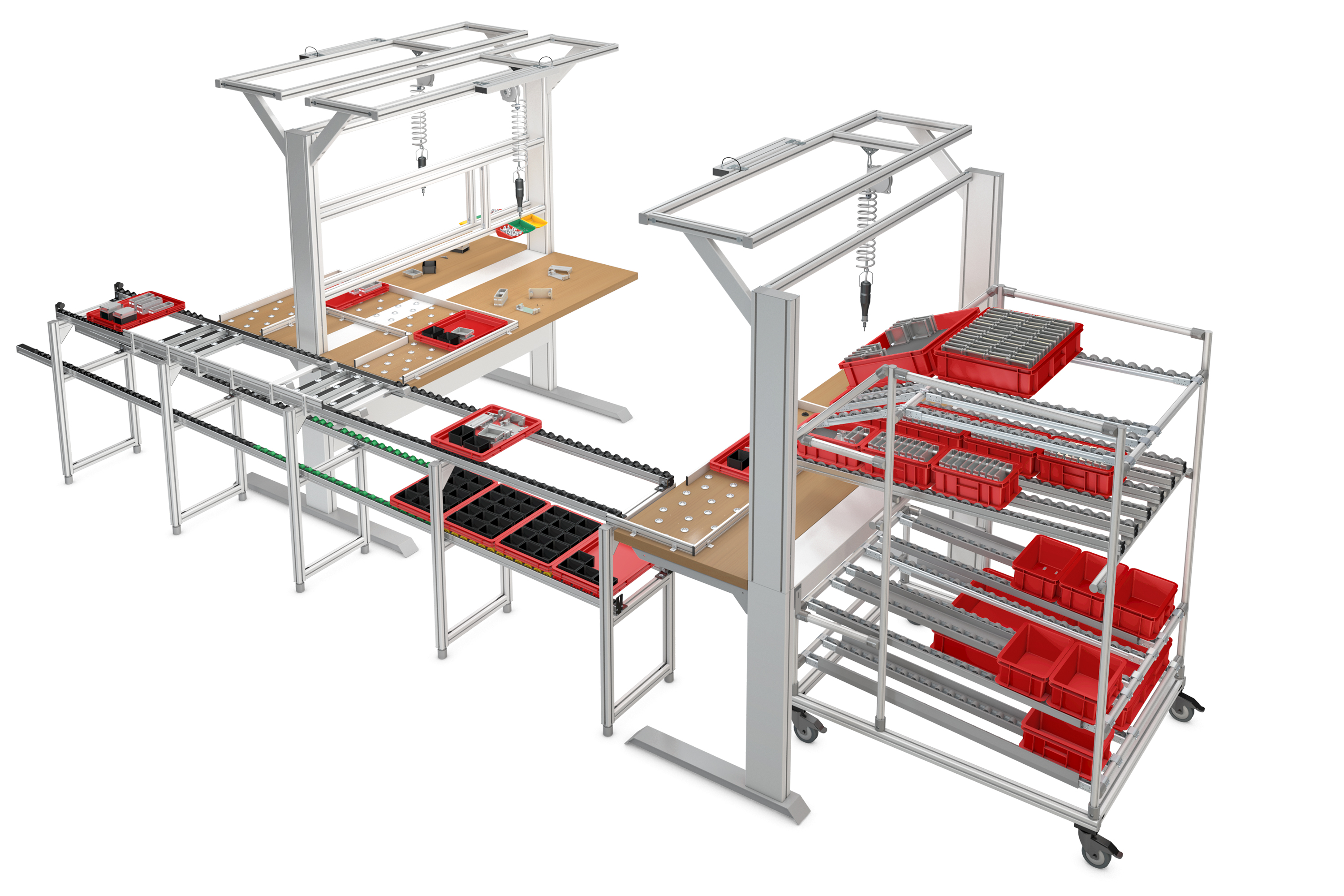
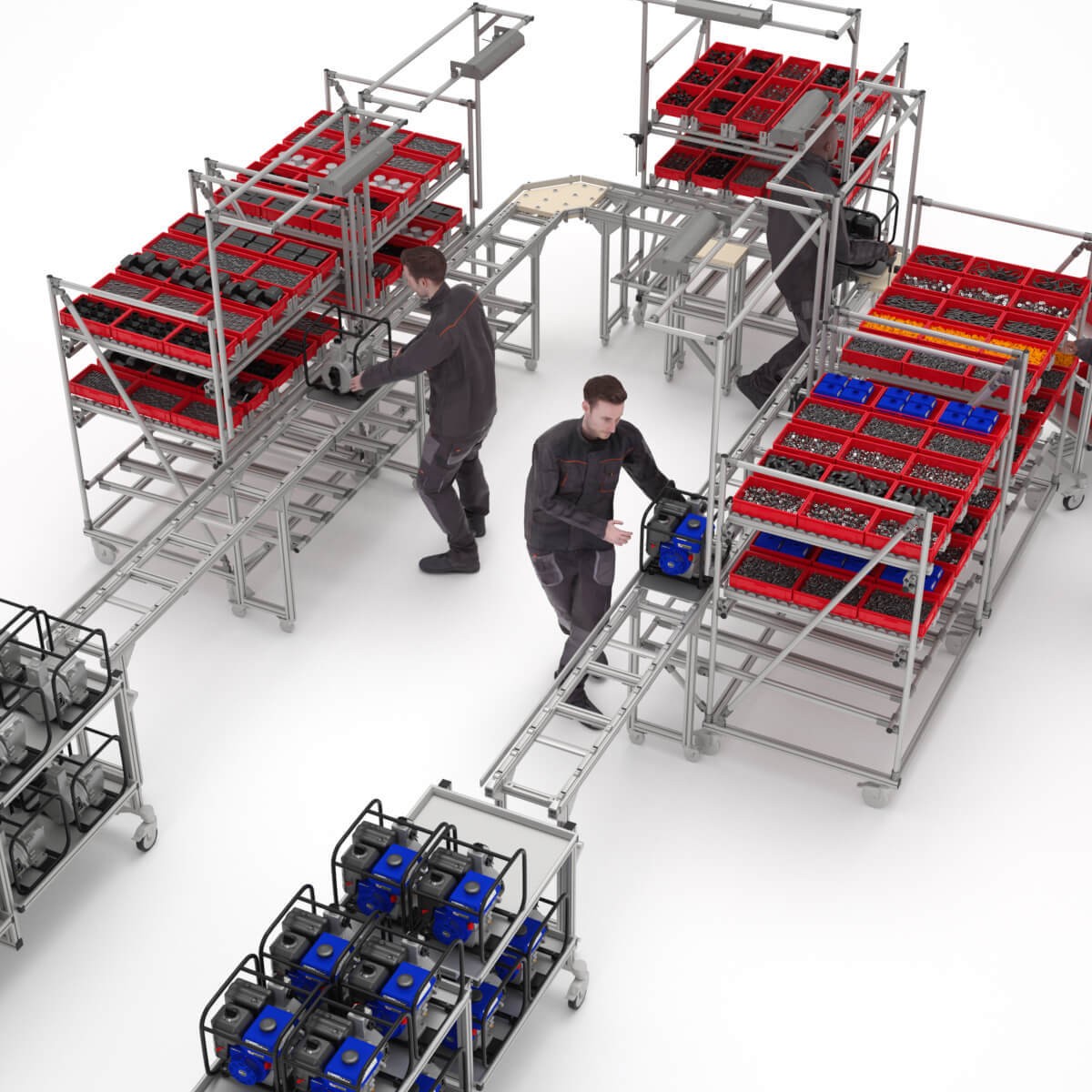
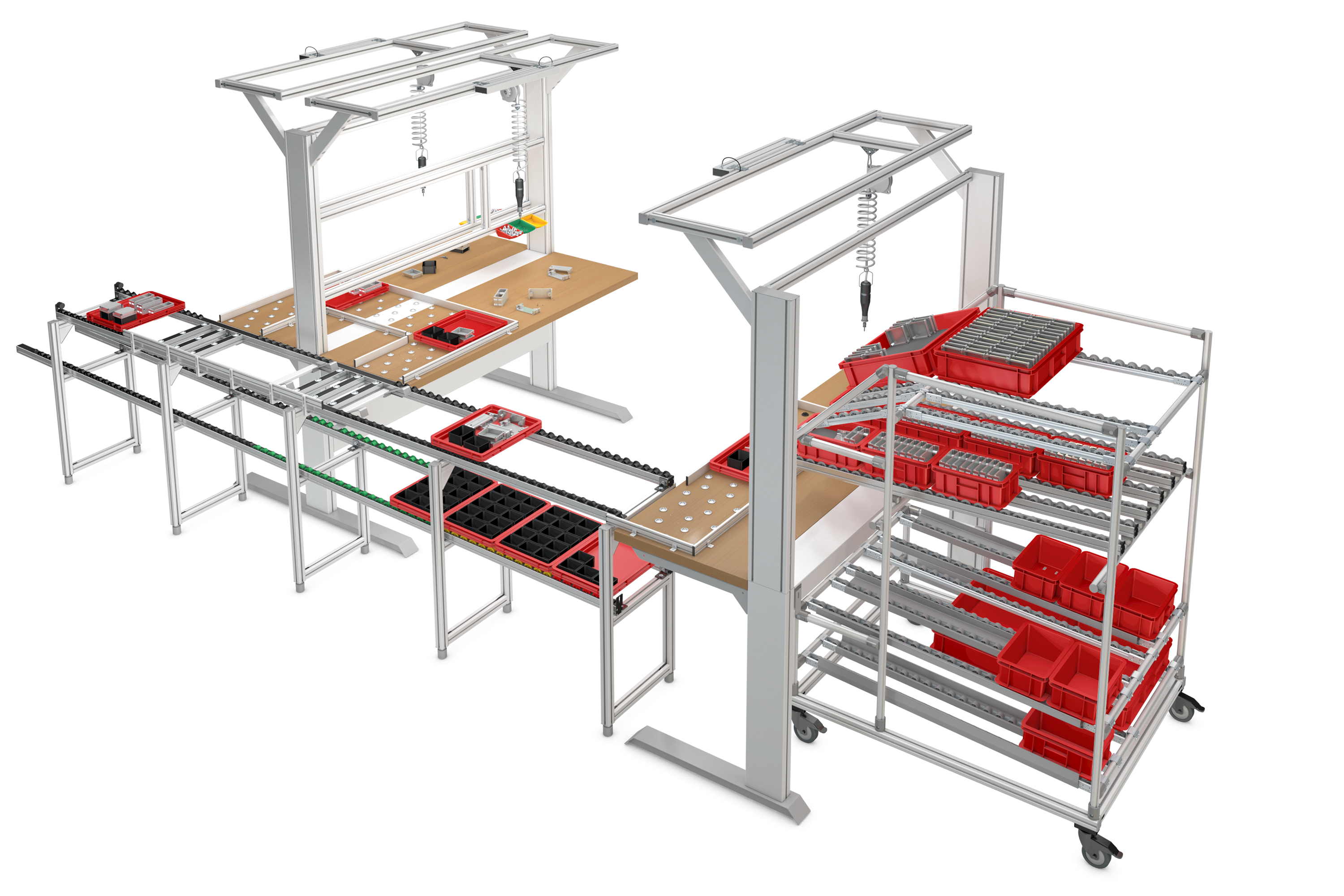
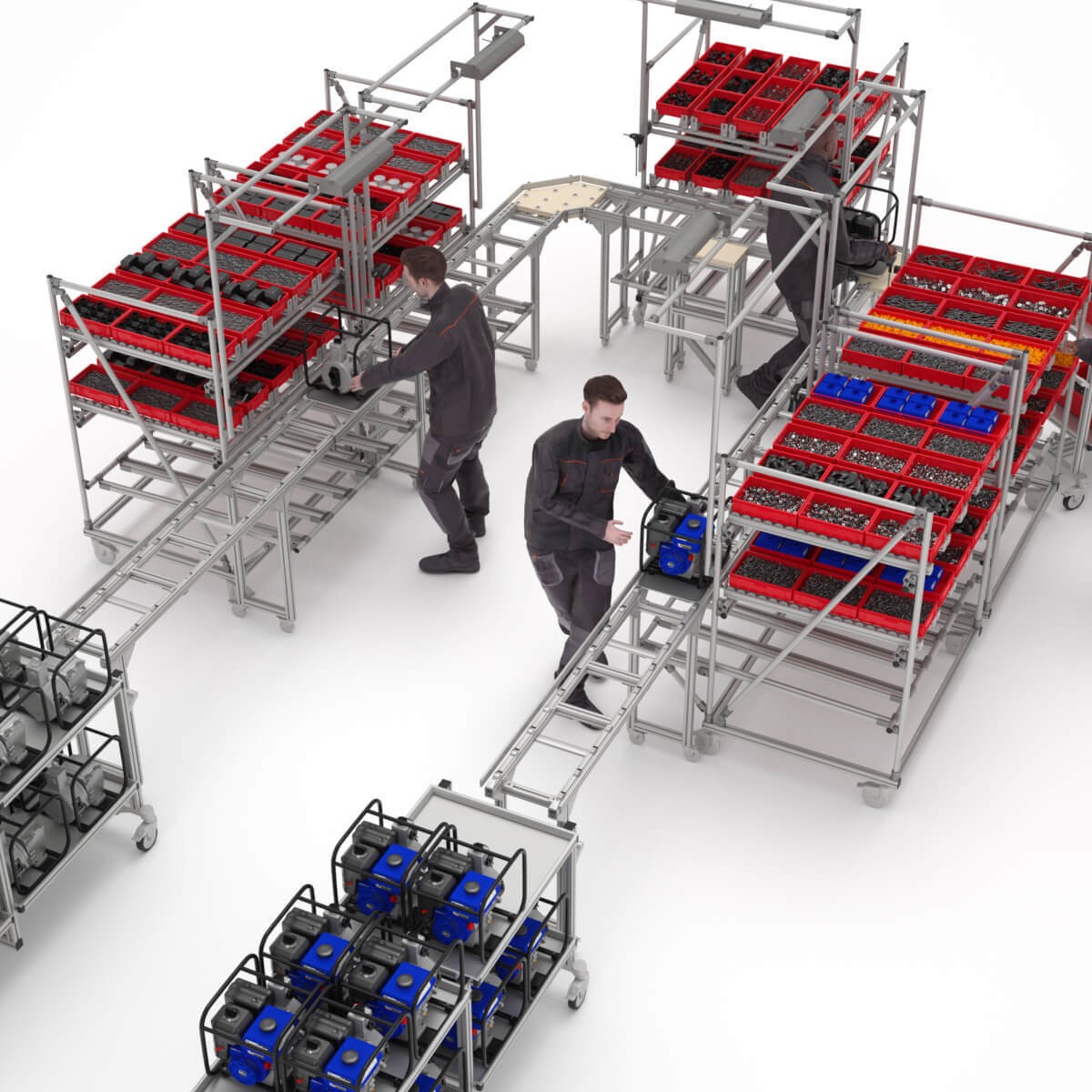
Die Gestaltung von Arbeitsplätzen für die Fließmontage sowie Montagelinien, bei denen Arbeitsplätze verkettet werden, ist ebenfalls möglich: Über Rollenbahnen, Förderbänder oder das One-Piece-Flow-Prinzip lassen sich Werkstücke effizient von Station zu Station transportieren und bearbeiten. Für einen reibungslosen Materialfluss sorgen unter anderem Durchlaufregale, mobile Roboter oder Karakuri/LCA-Anwendungen.
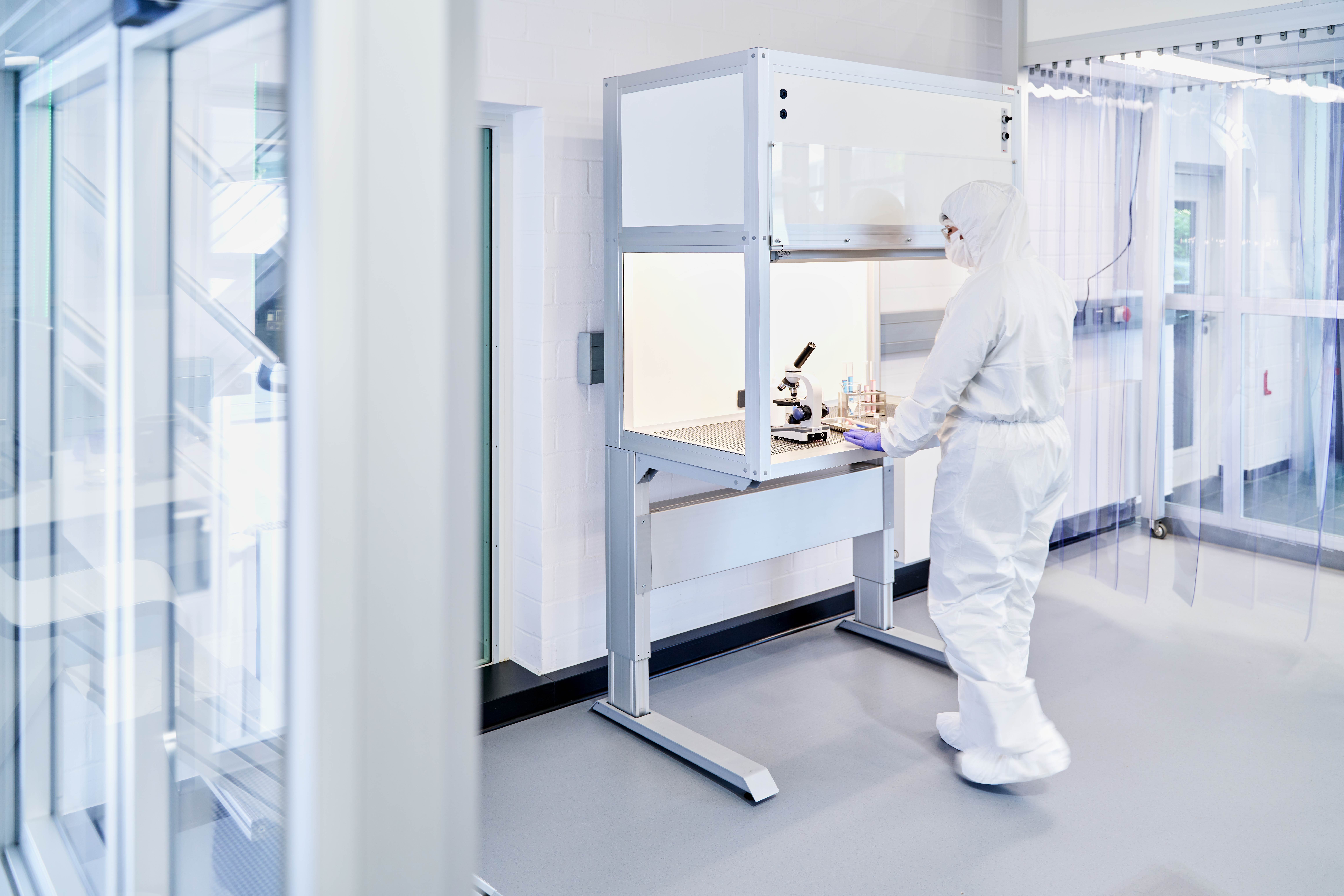
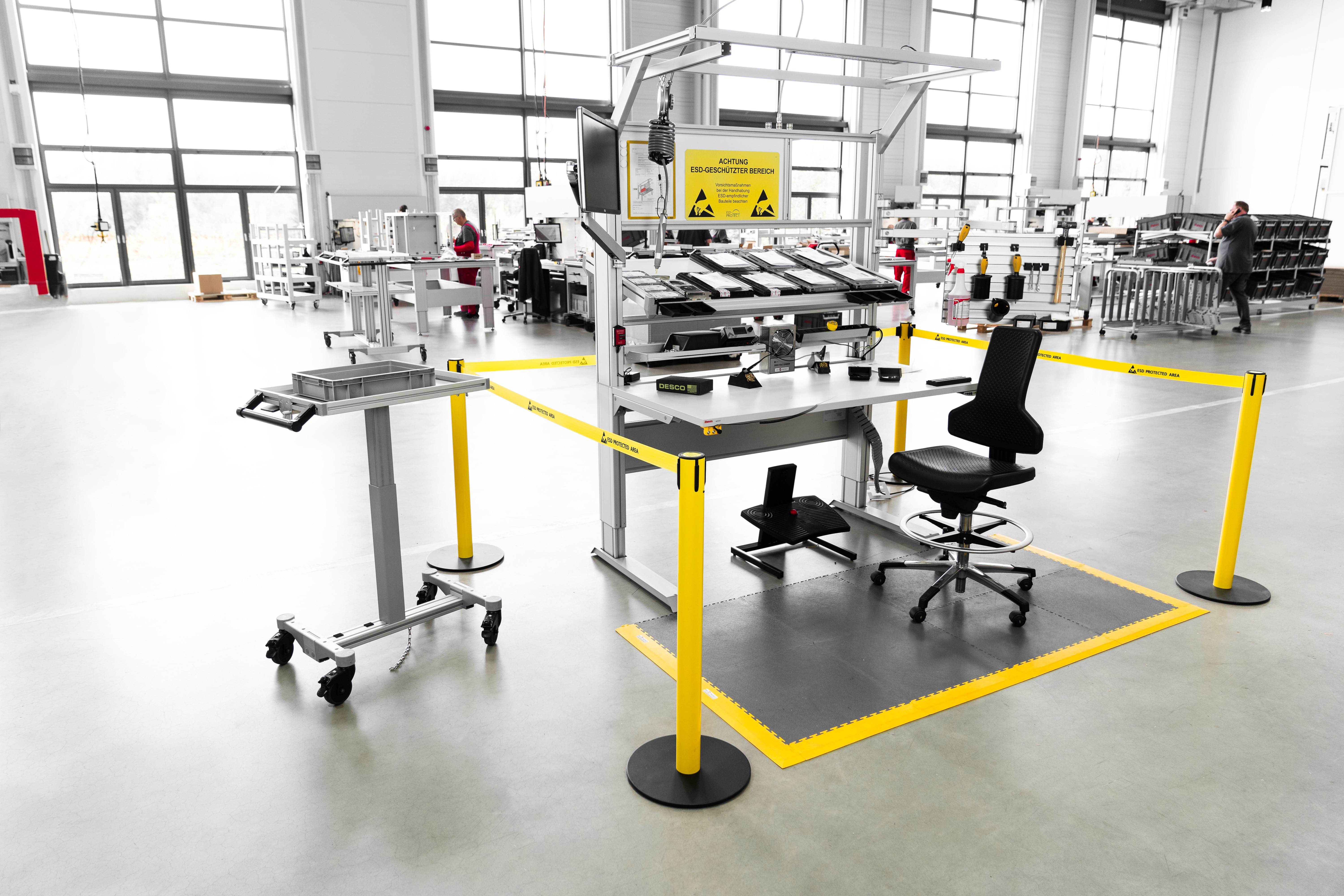
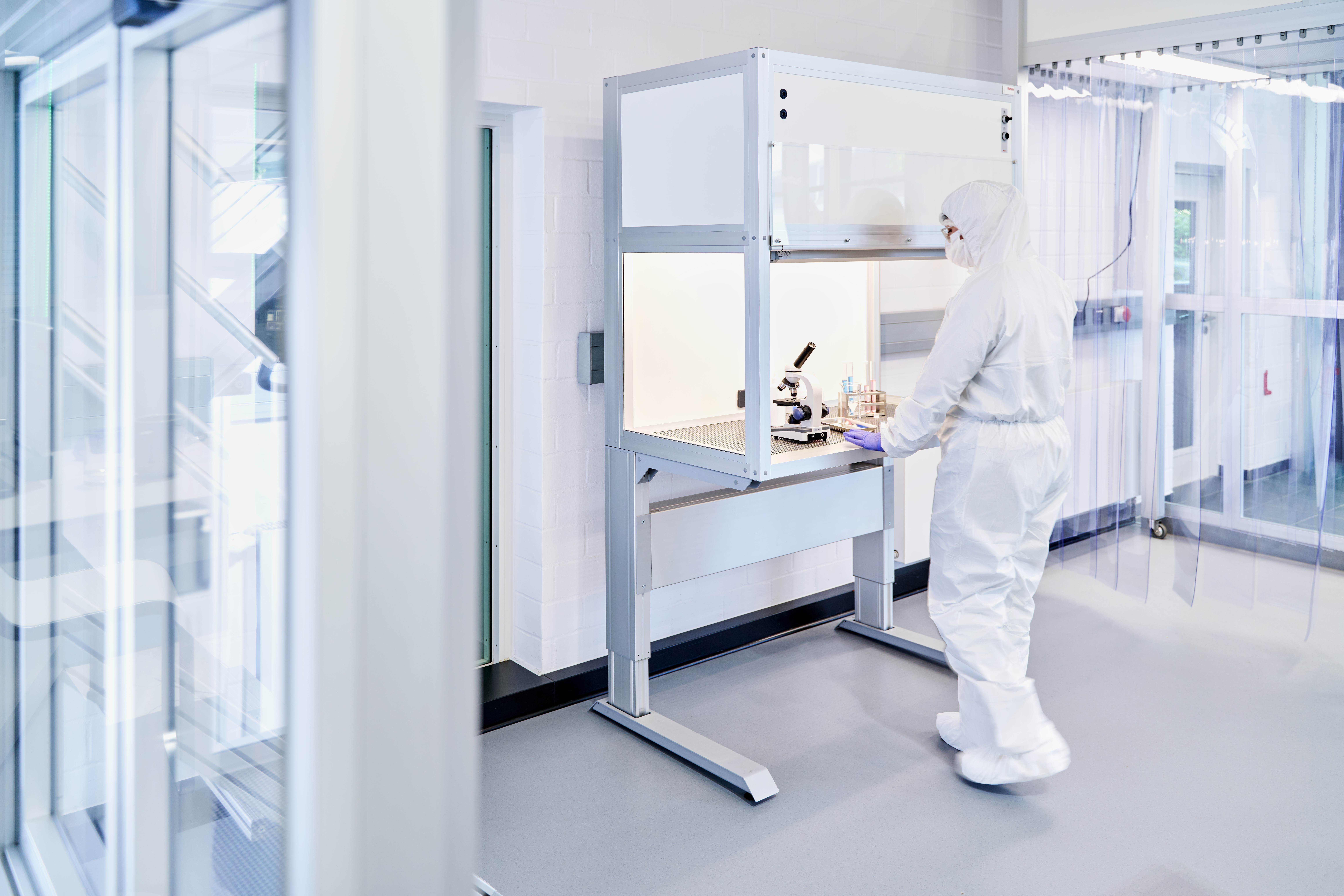
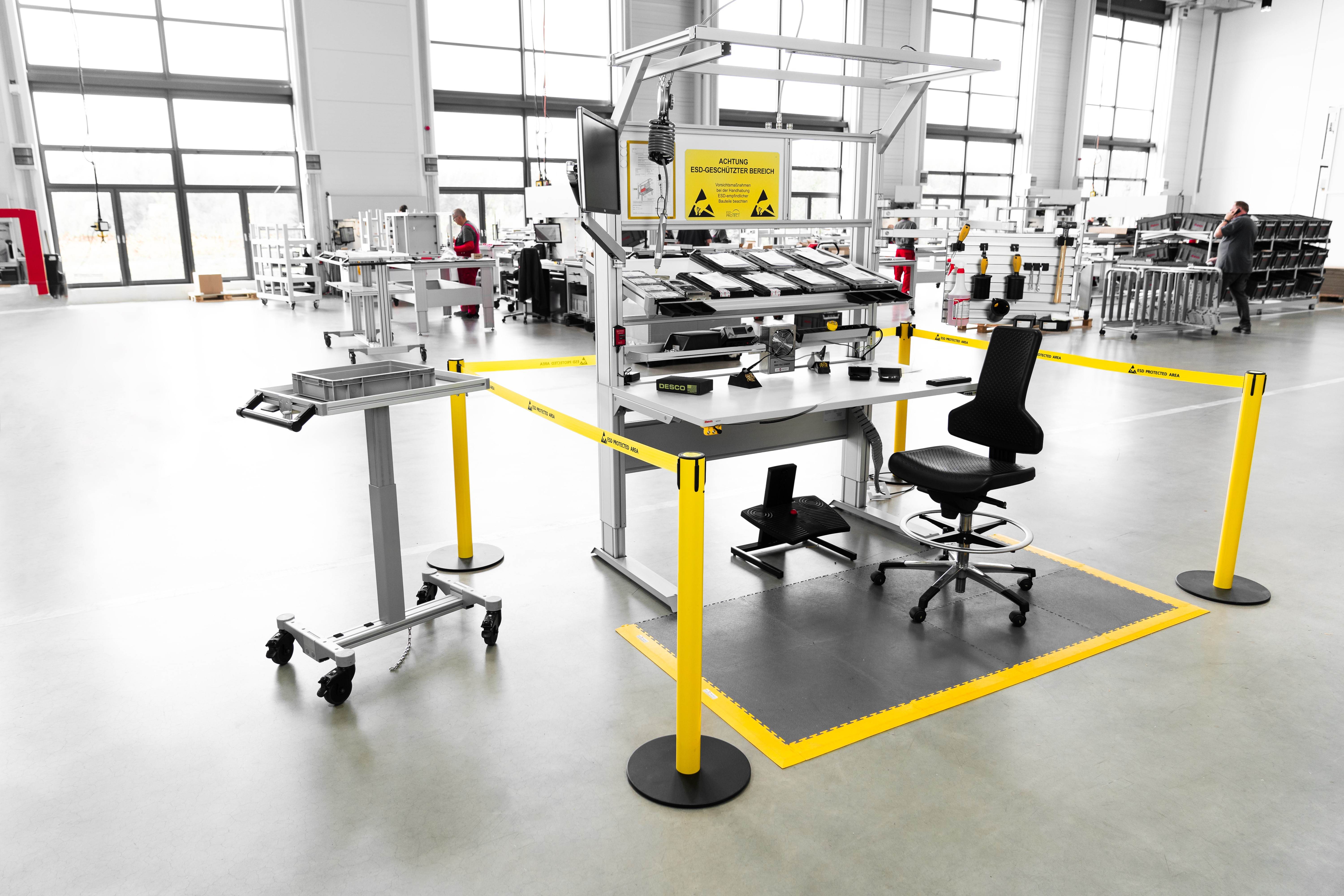
Für besondere Anforderungen, etwa in der Halbleiterfertigung oder Medizintechnik, lassen sich Arbeitsplätze mit ESD-Schutz ausstatten. Mit industriellen Arbeitsplatzsystemen wie dem item Arbeitsplatzsystem, gestalten Sie außerdem Werkbänke für den Einsatz im Reinraum. Auch Arbeitsplätze für die Zusammenarbeit mit Cobots sind mit Arbeitsplatzsystemen möglich. Dafür gibt es spezielle kollaborative Arbeitsplätze mit Roboter-spezifischer Montageplatte.
Die Gestaltung von Arbeitsplätzen für die Fließmontage sowie Montagelinien, bei denen Arbeitsplätze verkettet werden, ist ebenfalls möglich: Über Rollenbahnen, Förderbänder oder das One-Piece-Flow-Prinzip lassen sich Werkstücke effizient von Station zu Station transportieren und bearbeiten. Für einen reibungslosen Materialfluss sorgen unter anderem Durchlaufregale, mobile Roboter oder Karakuri/LCA-Anwendungen.
Für besondere Anforderungen, etwa in der Halbleiterfertigung oder Medizintechnik, lassen sich Arbeitsplätze mit ESD-Schutz ausstatten. Mit industriellen Arbeitsplatzsystemen wie dem item Arbeitsplatzsystem, gestalten Sie außerdem Werkbänke für den Einsatz im Reinraum. Auch Arbeitsplätze für die Zusammenarbeit mit Cobots sind mit Arbeitsplatzsystemen möglich. Dafür gibt es spezielle kollaborative Arbeitsplätze mit Roboter-spezifischer Montageplatte.
Was bietet das item Arbeitsplatzsystem?
Das item Arbeitsplatzsystem bietet eine durchgängig modulare Lösung für die ergonomische Gestaltung industrieller Arbeitsplätze. Das Angebot umfasst höhenverstellbare Arbeitstische, ergonomische Stühle sowie Komponenten für die Material- und Werkzeugbereitstellung. Ergänzt wird es durch Spezialkomponenten für ESD-Schutz und Reinraumbedingungen.
Dank des Baukastenprinzips lassen sich alle Komponenten flexibel miteinander kombinieren und nachträglich anpassen. Für die Planung stehen kostenfreie item Online Konfiguratoren, wie der item Arbeitsplatz-Konfigurator oder das item Engineeringtool, zur Verfügung. Im Online Shop finden sich zudem vorkonfigurierte Anwendungsbeispiele. Diese Musterlösungen können direkt eingesetzt oder als Basis für individuelle Konstruktionen genutzt und online angepasst werden.
Dank des Baukastenprinzips lassen sich alle Komponenten flexibel miteinander kombinieren und nachträglich anpassen. Für die Planung stehen kostenfreie item Online Konfiguratoren, wie der item Arbeitsplatz-Konfigurator oder das item Engineeringtool, zur Verfügung. Im Online Shop finden sich zudem vorkonfigurierte Anwendungsbeispiele. Diese Musterlösungen können direkt eingesetzt oder als Basis für individuelle Konstruktionen genutzt und online angepasst werden.
-
Beispielsätze:
- Arbeitsplatzsysteme bilden die Grundlage für eine ergonomische, effiziente und sichere manuelle Fertigung in der Industrie.
- Mit modularen Arbeitsplatzsystemen lassen sich Produktionsumgebungen schnell an neue Produkte, Prozesse und Mitarbeitende anpassen.
- Ergonomische Arbeitsplatzsysteme reduzieren körperliche Belastungen, steigern die Konzentration und tragen so nachhaltig zur Produktqualität bei.

Work bench systems
Description:
Definition
What are work bench systems?
Work bench systems are carefully coordinated systems consisting of standardised components – such as aluminium profiles, tables, chairs, accessories and expansion parts – that can be used in a flexible way to create application-specific work benches for industry. A work bench system provides the structural and functional basis for manual production tasks.
Unlike an office desk or an individual workstation, a work bench system includes all the elements workers need to carry out their tasks efficiently, safely and in comfort. These elements include the work surface, lighting, and tool stowage and material supply solutions, for example.
The item Work Bench System is an example of this kind of modular system. It is based on an end-to-end building kit principle that supports fully flexible ergonomic work bench design and customisation options.
Unlike an office desk or an individual workstation, a work bench system includes all the elements workers need to carry out their tasks efficiently, safely and in comfort. These elements include the work surface, lighting, and tool stowage and material supply solutions, for example.
The item Work Bench System is an example of this kind of modular system. It is based on an end-to-end building kit principle that supports fully flexible ergonomic work bench design and customisation options.
Good to know
What are the defining features of work bench systems for industry?
Boasting a perfect interplay of ergonomics, modularity, process reliability and efficiency, industrial work bench systems provide optimum support for manual production processes. Work bench systems can be adapted to suit different processes as well as individual workers’ physical needs.
Height-adjustable work benches, adjustable lighting and material supply solutions within easy reach protect workers’ health and boost productivity at the same time. Short reaching distances, structured storage solutions (for example, based on the FIFO principle) and a direct connection to conveyor belts or roller conveyors mean staff don’t have to walk or move around unnecessarily, so they can spend more time on tasks that add value.
In industry, work benches often need to be reconfigured fast, such as when production processes change or a new product is introduced. When solutions are based on a building kit principle, work benches, shelves, racks and holders can be quickly extended and adapted to suit new products and processes. It is crucial that reconfiguration of this kind does not mean compromising on ergonomics or safety. That’s why, for example, industrial work bench systems offer the option of fitting work benches with electrostatically dissipative components – to protect sensitive electronics against electrostatic discharge (ESD).
The item Work Bench System combines all these features in an end-to-end modular system – the first of its kind to be given the seal of approval from the Campaign for Healthy Backs (AGR).
Height-adjustable work benches, adjustable lighting and material supply solutions within easy reach protect workers’ health and boost productivity at the same time. Short reaching distances, structured storage solutions (for example, based on the FIFO principle) and a direct connection to conveyor belts or roller conveyors mean staff don’t have to walk or move around unnecessarily, so they can spend more time on tasks that add value.
In industry, work benches often need to be reconfigured fast, such as when production processes change or a new product is introduced. When solutions are based on a building kit principle, work benches, shelves, racks and holders can be quickly extended and adapted to suit new products and processes. It is crucial that reconfiguration of this kind does not mean compromising on ergonomics or safety. That’s why, for example, industrial work bench systems offer the option of fitting work benches with electrostatically dissipative components – to protect sensitive electronics against electrostatic discharge (ESD).
The item Work Bench System combines all these features in an end-to-end modular system – the first of its kind to be given the seal of approval from the Campaign for Healthy Backs (AGR).
What components do industrial work bench systems include?
Industrial work bench systems, such as the item Work Bench System, consist of a number of carefully coordinated components:
Work bench: This forms the base and should be chosen according to the required load-bearing capacity. It should ideally be height-adjustable so it can be adapted to suit different employees’ heights and working postures.
Chair: An ergonomic chair is added to each work bench. Featuring an adjustable back rest, the chair helps staff adopt a healthy posture and sit dynamically – in other words, change their position and posture frequently.
Tool stowage and material supply solutions: Components such as pivot arms, parts containers, drawers, tool walls such as the item toolpanel® and material trolleys of all kinds are used for this purpose.
Lighting: Lighting at the work bench should ensure glare-free illumination of the work area, with minimal shadows. Neutral white LED light of around 4000 kelvin is ideal. Read our free fact sheet to find out about the factors that affect lighting.
Power and data supply: An industrial work bench must be supplied with power, compressed air and data. What’s more, it needs to be equipped with elements for displaying information, such as document holders, pivot arms or magnetic panels.
Work bench: This forms the base and should be chosen according to the required load-bearing capacity. It should ideally be height-adjustable so it can be adapted to suit different employees’ heights and working postures.
Chair: An ergonomic chair is added to each work bench. Featuring an adjustable back rest, the chair helps staff adopt a healthy posture and sit dynamically – in other words, change their position and posture frequently.
Tool stowage and material supply solutions: Components such as pivot arms, parts containers, drawers, tool walls such as the item toolpanel® and material trolleys of all kinds are used for this purpose.
Lighting: Lighting at the work bench should ensure glare-free illumination of the work area, with minimal shadows. Neutral white LED light of around 4000 kelvin is ideal. Read our free fact sheet to find out about the factors that affect lighting.
Power and data supply: An industrial work bench must be supplied with power, compressed air and data. What’s more, it needs to be equipped with elements for displaying information, such as document holders, pivot arms or magnetic panels.
What are the benefits of modular work bench systems?
Modular work bench systems boast exceptional flexibility, which is a great advantage for users. Thanks to the modular design of the system, components can be added, swapped or repositioned at any time, without having to replace the entire work bench. This saves money in the long term and enables users to respond swiftly to changing production requirements.
Another benefit is that modular work bench systems can be optimally adjusted to suit each individual worker’s physical needs. When tools and materials are organised logically and conveniently, this supports good working posture, optimises work processes and ensures staff can readily access what they need. What’s more, modular solutions can be seamlessly integrated into internal material flows by connecting them to conveyor belts and roller conveyors, for example.
The item Work Bench System embodies this principle perfectly. All components are coordinated with each other, and users can put them together online to design solutions to suit specific requirements.
Another benefit is that modular work bench systems can be optimally adjusted to suit each individual worker’s physical needs. When tools and materials are organised logically and conveniently, this supports good working posture, optimises work processes and ensures staff can readily access what they need. What’s more, modular solutions can be seamlessly integrated into internal material flows by connecting them to conveyor belts and roller conveyors, for example.
The item Work Bench System embodies this principle perfectly. All components are coordinated with each other, and users can put them together online to design solutions to suit specific requirements.
What’s the difference between a conventional work bench system and an ergonomic one?
In contrast to conventional work bench systems, the various elements of ergonomic work bench systems can be adjusted to suit each individual worker’s physical needs. By making it easy for staff to alternate between sitting and standing, the flexible height-adjustment option encourages more movement during the working day. This stimulates circulation, helps with concentration and boosts staff wellbeing.
With ergonomic work bench systems such as the item Work Bench System, the field of vision and handling area can also be adjusted to suit the individual worker, thanks to customised lighting and various types of material supply solutions, for instance. Besides supporting natural movements, ergonomic work bench systems help prevent postures that put strain on the body and cause tension and pain. Ergonomics is therefore about much more than preventing occupational accidents – the aim is also to protect staff and keep them healthy, motivated and efficient for as long as possible. Our free fact sheet explains how to set up an optimal field of vision and handling area.
With ergonomic work bench systems such as the item Work Bench System, the field of vision and handling area can also be adjusted to suit the individual worker, thanks to customised lighting and various types of material supply solutions, for instance. Besides supporting natural movements, ergonomic work bench systems help prevent postures that put strain on the body and cause tension and pain. Ergonomics is therefore about much more than preventing occupational accidents – the aim is also to protect staff and keep them healthy, motivated and efficient for as long as possible. Our free fact sheet explains how to set up an optimal field of vision and handling area.
How can work bench systems be used in production?
Industrial work bench systems cover a wide range of possible uses. The item Work Bench System can be used to build standalone workstations, for example – work benches where staff work on one product in one place.
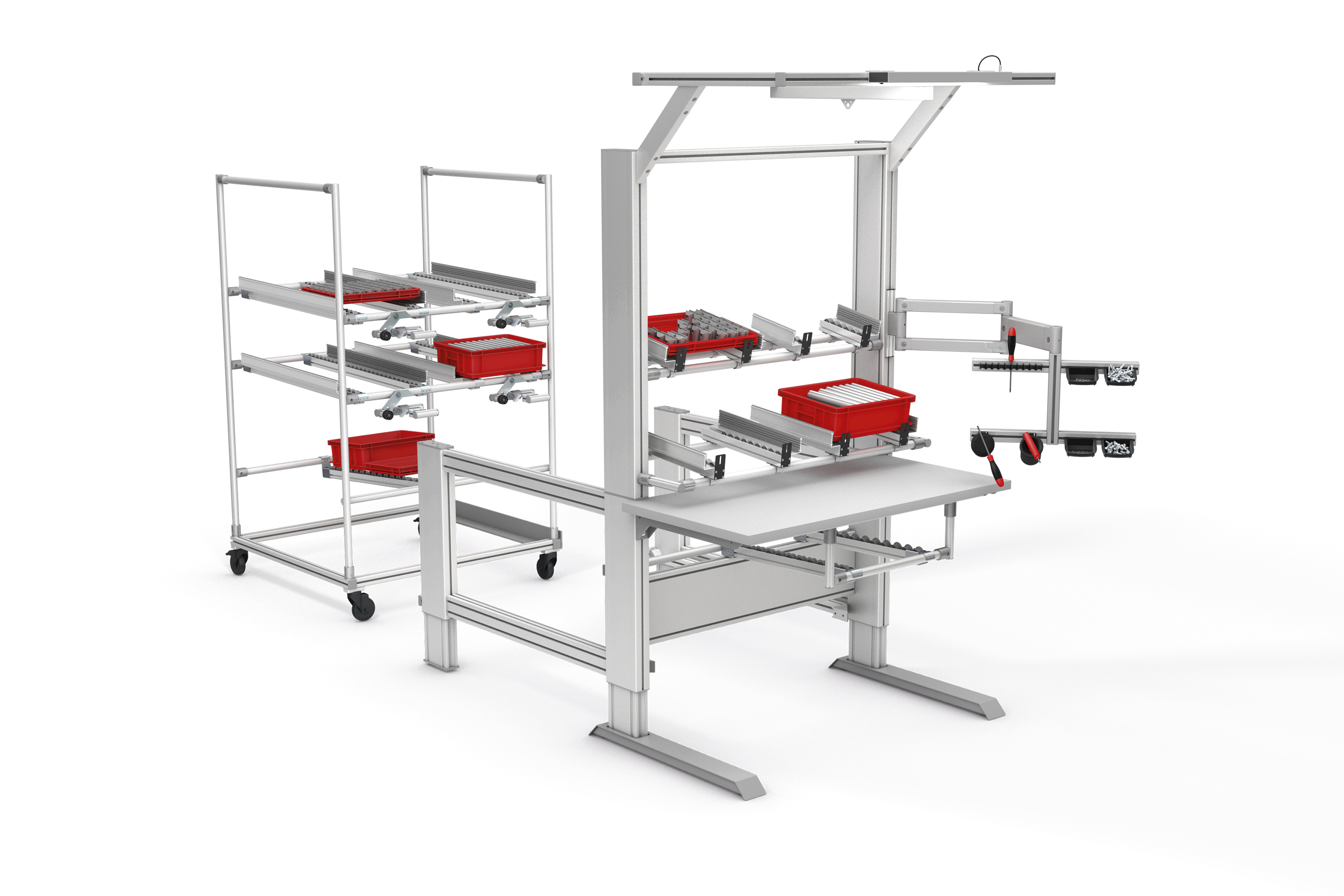
It is also possible to design work benches for flow production and assembly lines with interlinked work benches. By using roller conveyors and conveyor belts, or by applying the one-piece-flow principle, users can transport workpieces efficiently from one processing station to the next. Various solutions such as flow racks, mobile robots and Karakuri/LCA applications keep materials flowing smoothly.
To meet special requirements, such as in semiconductor manufacturing or the medical technology sector, you can equip work benches with ESD protection. By opting for an industrial work bench system such as the item Work Bench System, you can also design workstations that are suitable for use in cleanrooms. What’s more, you can design work benches for collaboration with cobots – special collaborative work benches with a robot-specific mounting plate are available for this purpose.
It is also possible to design work benches for flow production and assembly lines with interlinked work benches. By using roller conveyors and conveyor belts, or by applying the one-piece-flow principle, users can transport workpieces efficiently from one processing station to the next. Various solutions such as flow racks, mobile robots and Karakuri/LCA applications keep materials flowing smoothly.
To meet special requirements, such as in semiconductor manufacturing or the medical technology sector, you can equip work benches with ESD protection. By opting for an industrial work bench system such as the item Work Bench System, you can also design workstations that are suitable for use in cleanrooms. What’s more, you can design work benches for collaboration with cobots – special collaborative work benches with a robot-specific mounting plate are available for this purpose.
What does the item Work Bench System offer?
The item Work Bench System offers an end-to-end modular solution for designing ergonomic industrial work benches. The product range includes height-adjustable work benches, ergonomic chairs and components for tool stowage and material supply solutions. It also offers special components for ESD safety and cleanroom conditions.
Thanks to the building kit principle, all the components can be flexibly combined with each other – and solutions can subsequently be reconfigured, too. Free item online configurators, such as the item Work Bench Configurator and the item Engineeringtool, can be used to plan solutions. Preconfigured sample solutions are also available in the item Online Shop. You can use these exactly as they are or take them as a starting point and customise them online to design your own solutions.
Thanks to the building kit principle, all the components can be flexibly combined with each other – and solutions can subsequently be reconfigured, too. Free item online configurators, such as the item Work Bench Configurator and the item Engineeringtool, can be used to plan solutions. Preconfigured sample solutions are also available in the item Online Shop. You can use these exactly as they are or take them as a starting point and customise them online to design your own solutions.
-
Example sentences:
- Work bench systems provide the basis for ergonomic, efficient and safe manual production in industry.
- When modular work bench systems are used, production environments can be quickly adapted to suit new workers, products and processes.
- By reducing physical strain on workers and helping them concentrate, ergonomic work bench systems contribute towards product quality on a lasting basis.