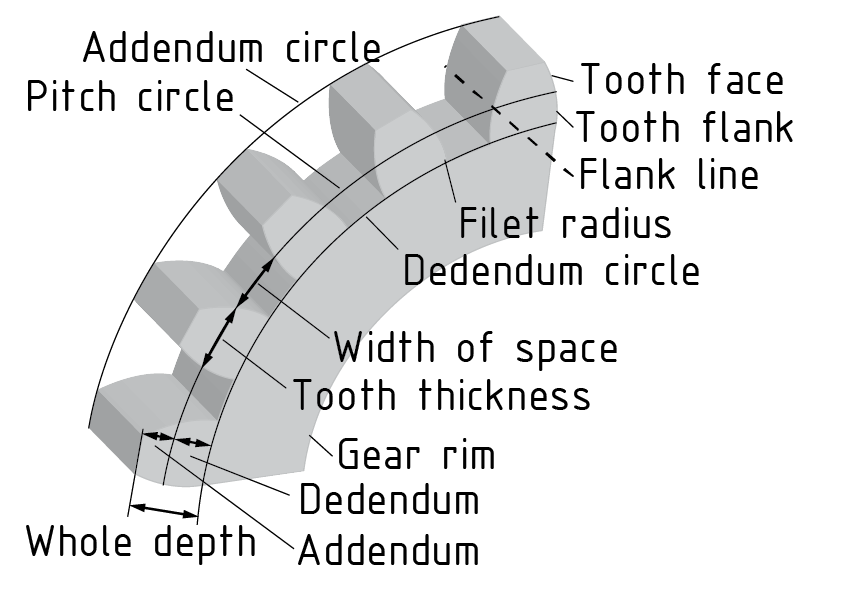

Evolventenverzahnung
Die Evolventenverzahnung ist die vorherrschende Verzahnungsart im Maschinenbau. Weil Richtung und Größe der Zahnnormalkraft während des Eingriffs konstant bleiben, übertragen sie Drehmomente sehr gleichmäßig. Zudem ist sie unempfindlich gegenüber Achsabstandsabweichungen und -änderungen.
Die Zahnflanken haben Evolventenform. Diese wird durch den Endpunkt einer Geraden erzeugt, die sich auf dem Grundkreis abwälzt. Die Evolventenform ist damit ausschließlich vom Grundkreis abhängig
Die erzeugende Gerade berührt die beiden Grundkreise und schneidet die Mittellinie im Wälzpunkt. An diesem kommt es zum reinen Wälzen, weil nur sehr geringe Reibung auftritt. Außenverzahnungen weisen wegen der konvexen Flanken jedoch hohe Flankenpressung und damit geringe Belastbarkeit auf.

involute gear teeth
Involute gearing
Involute gearing is the predominant type of gearing in Mechanical engineering. Since the direction and magnitude of the normal Force on the tooth remains constant when the gears are mated it transmits torque very uniformly. It is also resistant to deviations and alterations in axis distance.
The tooth flanks are shaped like the involute of a circle, i.e. the spiralling curve that is traced by the end point of an imaginary straight line unwinding itself from a base circle. The involute shape is thus exclusively dependent on the base circle and also determines the transmission ratio. Different tooth shapes and axis distances can be achieved by means of addendum modification. External gears have convex (protruding) tooth flanks and internal gears have concave (inverted) tooth flanks.
The imaginary straight line touches both base circles and transects the centre line at the pitch point, which is where a pure Rolling motion is generated because Friction is very low. However, due to its convex flanks, external gearing exhibits high flank pressure and thus low load-carrying capacity.
Involute gearing
Involute gearing is the predominant type of gearing in Mechanical engineering. Since the direction and magnitude of the normal Force on the tooth remains constant when the gears are mated it transmits torque very uniformly. It is also resistant to deviations and alterations in axis distance.
The tooth flanks are shaped like the involute of a circle, i.e. the spiralling curve that is traced by the end point of an imaginary straight line unwinding itself from a base circle. The involute shape is thus exclusively dependent on the base circle and also determines the transmission ratio. Different tooth shapes and axis distances can be achieved by means of addendum modification. External gears have convex (protruding) tooth flanks and internal gears have concave (inverted) tooth flanks.
The imaginary straight line touches both base circles and transects the centre line at the pitch point, which is where a pure Rolling motion is generated because Friction is very low. However, due to its convex flanks, external gearing exhibits high flank pressure and thus low load-carrying capacity.
involute teeth
involute toothing

dentado de envolvente
dientes de engrane de envolvente
Engranaje envolvente
El engranaje envolvente es el tipo predominante de engranaje en la ingeniería mecánica. Como la dirección y la magnitud de la fuerza normal en el diente permanecen constantes cuando los engranes se acoplan, este transmite el torque de manera muy uniforme. También es resistente a las desviaciones y las alteraciones en la distancia del eje.
Los flancos de diente se conforman como el envolvente de un círculo, es decir, la curva en espiral que es trazada por el punto final de una línea recta imaginaria desenvolviéndose de un círculo base. La forma envolvente es, por lo tanto, exclusivamente dependiente del círculo base y también determina la relación de transmisión. Se pueden lograr diferentes formas de dientes y de distancias de eje por medio de la modificación del addendum. Los engranes exteriores cuentan con flancos de diente convexos (proyectados) y los engranes internos tienen flancos de diente cóncavos (invertidos).
La línea recta imaginaria toca ambos círculos base y hace transección en la línea central en el punto primitivo, que es donde el movimiento de rodaje puro es generado debido a que la fricción es muy baja. Sin embargo, debido a sus flancos convexos, el engranaje exterior muestra una alta presión de flanco y por lo tanto una baja capacidad de carga.
Engranaje envolvente
El engranaje envolvente es el tipo predominante de engranaje en la ingeniería mecánica. Como la dirección y la magnitud de la fuerza normal en el diente permanecen constantes cuando los engranes se acoplan, este transmite el torque de manera muy uniforme. También es resistente a las desviaciones y las alteraciones en la distancia del eje.
Los flancos de diente se conforman como el envolvente de un círculo, es decir, la curva en espiral que es trazada por el punto final de una línea recta imaginaria desenvolviéndose de un círculo base. La forma envolvente es, por lo tanto, exclusivamente dependiente del círculo base y también determina la relación de transmisión. Se pueden lograr diferentes formas de dientes y de distancias de eje por medio de la modificación del addendum. Los engranes exteriores cuentan con flancos de diente convexos (proyectados) y los engranes internos tienen flancos de diente cóncavos (invertidos).
La línea recta imaginaria toca ambos círculos base y hace transección en la línea central en el punto primitivo, que es donde el movimiento de rodaje puro es generado debido a que la fricción es muy baja. Sin embargo, debido a sus flancos convexos, el engranaje exterior muestra una alta presión de flanco y por lo tanto una baja capacidad de carga.

渐开线啮合