
Deutsch

Festigkeit (Feminin)

Beschreibung:

Die Festigkeit ist die maximale Spannung, mit der ein Werkstoff in einem gegebenen Querschnitt beansprucht werden kann. Damit charakterisiert die Festigkeit das Widerstandsverhalten eines Werkstoffes gegen Verformung. Sie wird anhand einer maximalen Kraft bei einer bestimmten Dehnung oder einem bestimmten Fließverhalten auf die unverformte Querschnittsfläche des Werkstoffes definiert. Festigkeiten sind dabei nicht die wirklich auftretenden Spannungen, sondern werden meist aus den Nennspannungen errechnet, also aus der Prüfkraft sowie den Querschnitten vor Versuchsbeginn.

Je nach Art der Beanspruchung werden unterschiedliche Festigkeiten definiert, z. B.:

  • Zugfestigkeit
  • Druckfestigkeit
  • Kompressionsfestigkeit
  • Knickfestigkeit
  • Torsionsfestigkeit
  • Scherfestigkeit

Differenziert wird zudem nach der Ein- oder Mehrachsigkeit der Beanspruchung und ob eine Belastung statisch oder dynamisch auf das Bauteil aufgebracht wird. Unterschieden werden dann etwa:

  • Ruhende Festigkeit
  • Ansteigende Festigkeit
  • Zeitfestigkeit
  • Dauerfestigkeit
  • Ermüdungsfestigkeit
    Beispielsätze:
  • Die hohe Zugfestigkeit bietet zusätzliche Sicherheit gegen Bruch.
  • Mechanische Werte (gelten nur in Pressrichtung)Zugfestigkeit Rmmin.
  • Bei Überschreitung der statischen Festigkeit schürt die Zugprobe ein.

English

resistance (Neutrum)

Description: Electrical - or ohmic - resistance occurs when moving charge carriers collide with Conductor atoms. This impedes uniform charge carrier motion - the current flow. The greater the conductor material's cross-section, the lower the conductor's resistance. This is because the electrons have more space in the conductor with the same current intensity (= same number of charge carriers), so there are fewer collisions with the metallic lattice. Similarly, the resistance increases with the length of the conductor, because a Collision is more likely over a longer distance. In the case of metallic conductors, resistance increases as the temperature rises (PTC resistor). Semi-conductors are NTC thermistors, i.e. their resistance decreases as the temperature increases. In mathematical terms, the electrical resistance R expresses the relationship between voltage V and current I. In a circuit with ohmic resistance only, Ohm's law applies: $R = V/I$. In an electrical circuit with inductances or capacitances, the Impedance is derived from the effective resistance and the reactance.
    Example sentences:
  • Roll the tool along the Profile until there is no discernible rolling resistance.
  • The transparent polycarbonate panel offers good impact resistance.
  • Perfect for transporting sensitive or delicate goods and with extremely low rolling resistance.
English

rigidity (Neutrum)

Description: A material's rigidity can be indicated by the modulus of elasticity. High rigidity and long service life combine with minimum maintenance. Compound Material has good shear rigidity, flexural strength and buckling strength.
    Example sentences:
  • A material's rigidity can be indicated by the modulus of elasticity.
  • High rigidity and long service life combine with minimum maintenance.
  • Compound Material has good shear rigidity, flexural strength and buckling strength.
English

strength (Neutrum)

Description: A material's strength is the maximum stress to which a given cross-section of that Material can be subjected. It therefore indicates the material's Resistance to deformation. A maximum Force on the material's non-deformed cross-sectional area for a specific elongation or specific flow characteristics is used to define the strength. Strength values are not the stresses that actually occur. In most cases, they are calculated from the nominal stresses, i.e. from the test force and the cross-sections prior to the start of the test. Different strengths are defined depending on the type of stress. They include: Tensile strength Compressive strength Bulk strength Buckling strength Torsional strength Shear strength A further distinction is made according to whether the stress is uniaxial or multiaxial and whether a static or dynamic stress is applied to the component. This results in a differentiation between e.g.: Static strength Increasing strength Finite-life fatigue strength Fatigue limit Fatigue strength
    Example sentences:
  • Compound Material has good shear rigidity, flexural strength and buckling strength.
  • Its high tensile strength offers additional security against rupture.
  • The dual screw connection provides additional strength.
  • A person's physical strength will also vary according to their age, body size, weight and gender.

Spanisch

fuerza (Neutrum)

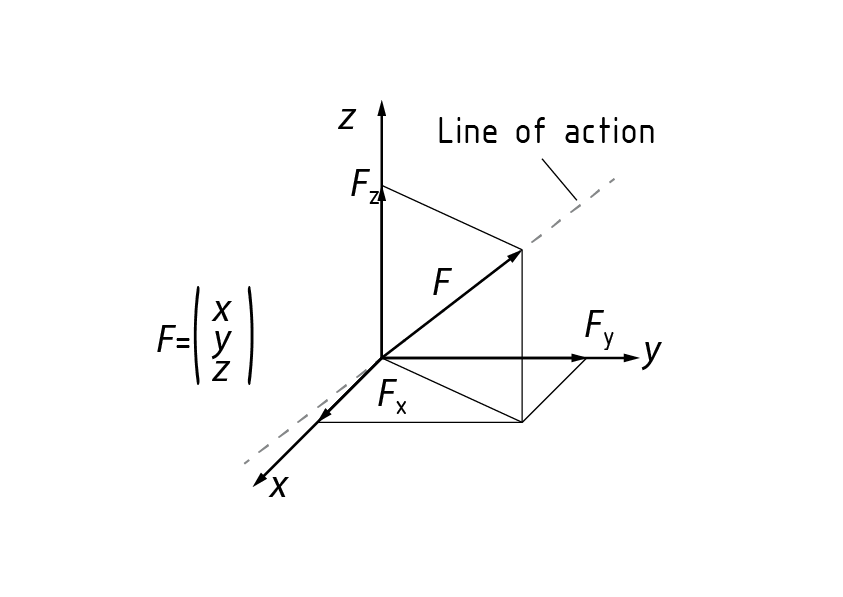
Description: Una fuerza F genera un cambio de movimiento o cambio de forma. La unidad de medición para la fuerza es el newton N, que está compuesto de las siguientes unidades: kilogramos, metros, segundos al cuadrado $kg?m?s^{-2} $. Se puede representar como una cantidad de vector basada en su magnitud, dirección y ubicación. Este vector de fuerza se puede mover libremente a lo largo de su línea de acción. En un espacio tridimensional, la fuerza se describe con los componentes $F_{X}$ , $F_{Y}$ y $F_{Z}$ , donde que cada uno representa una dimensión diferente. Cuando una fuerza actúa en un cuerpo mediante un brazo de palanca, se genera un momento y el cuerpo es rotado. Un desglose de los componentes en un vector de fuerza F
Un desglose de los componentes en un vector de fuerza F
Spanisch

resistencia (Neutrum)

Description: La resistencia de un material es el esfuerzo máximo a la que una sección dada de un material puede someterse. Por lo tanto, esto indica la resistencia a la deformación del material. Una fuerza máxima sobre el área de la sección no deformada del material para una elongación específica o para características de flujo específicas se usa para definir la resistencia. Los valores de resistencia no son esfuerzos que realmente ocurren. En la mayoría de los casos, son calculados a partir de los esfuerzos nominales, es decir, de la fuerza de prueba y de las secciones anteriores al inicio de la prueba. Se definen diferentes resistencias dependiendo del tipo de esfuerzo. Estas incluyen: Resistencia a la tensión Resistencia a la compresión Resistencia aparente Resistencia al pandeo Resistencia a la torsión Resistencia al corte También se distingue entre el esfuerzo uniaxial y multiaxial, y si se aplica un esfuerzo estático o dinámico en el componente. Esto resulta en una diferenciación entre, por ejemplo: Resistencia estática Resistencia en incremento Resistencia a la fatiga de vida finita Límite de fatiga Resistencia a la fatiga
Spanisch

rigidez (Neutrum)

Chinesisch

刚性 (Neutrum)

Chinesisch

强度 (Neutrum)

Description: 一种材料的强度是指该材料的给定横截面能够承受的最大应力。因此它可以表示材料的抗变形力。在特定伸长率或特定流动特性范围内,材料未变形横截面面积上能够承受的最大力就是材料的强度。强度值不是实际产生的应力。在大多数情况下,通过公称应力计算强度,即通过试验中施加的力和试验开始前的横截面来计算。 根据应力的类型,强度可分为: 拉伸强度 压缩强度 整体强度 压曲强度 扭转强度 剪切强度 还可以根据施加在构件上的应力是单轴或多轴、静态或动态,而将强度以此分为: 静强度 增量强度 有限寿命疲劳强度 疲劳极限 疲劳强度