

Gesichtsfeld
Zum Gesichtsfeld gehören alle Punkte, die bei gerade und bewegungslos gehaltenen Kopf und Augen wahrzunehmen sind. Unterschieden werden die monokularen Gesichtsfelder des linken und rechten Auges und das binokulare Gesichtsfeld beider Augen.
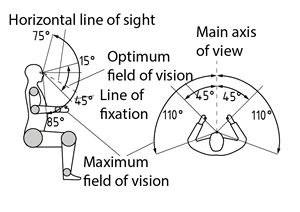
Ein Erwachsener hat binokular horizontal ein maximales Gesichtsfeld von rund 180°, vertikal von ca. 60° nach oben und 70° nach unten. Das optimale Gesichtsfeld liegt horizontal wie auch vertikal jeweils 15° auf beiden Seiten der Hauptsehachse. Hier sollten sich die am häufigsten betrachteten Gegenstände befinden.
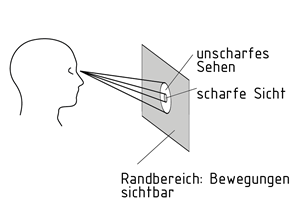
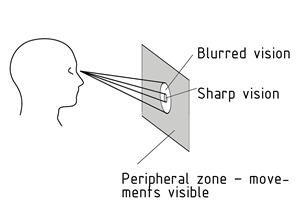
Der Winkel, in dem scharf gesehen wird, umfasst ca. 1 - 2°. Im Mittelfeld bis etwa 40° werden nur starke Kontraste, am Rand des Gesichtsfeldes nur bewegte Objekte wahrgenommen.
Die maximale Ausdehnung des Gesichtsfeldes ist individuell verschieden. Ab einem Lebensalter von 55 Jahren verringert sich vor allem die mögliche Aufwärtsbewegung der Augen.
Am ergonomischen Arbeitsplatz sollten die gleichzeitig zu überwachenden Objekte im Gesichtsfeld angeordnet sein.
Das Gesichtsfeld wird vom Blickfeld unterschieden.
-
Beispielsätze:
- Die maximale Ausdehnung des Gesichtsfeldes ist individuell verschieden.
- Am ergonomischen Arbeitsplatz sollten die gleichzeitig zu überwachenden Objekte im Gesichtsfeld angeordnet sein.
- Zum Gesichtsfeld gehören alle Punkte, die bei gerade und bewegungslos gehaltenen Kopf und Augen wahrzunehmen sind.

field of vision
-
Example sentences:
- A person's field of vision is the area within which they can fix their eyes directly and centrally on any object.
- Wherever possible, other printed work instructions should be positioned to the left, within the operator's field of vision, or higher up.
- Field of vision and field of view (Sehfeld?
visual field
-
Example sentences:
- At ergonomic workstations, items that are to be monitored simultaneously should be positioned within the visual field.
- The visual field includes all points that can be seen when looking straight ahead, without moving the head or eyes.
- The visual field describes the area within which a person can see objects without having to move their head or eyes.

campo de visión

Campo visual
El campo visual incluye todos los puntos que pueden ser vistos cuando se ve hacia el frente, sin mover la cabeza o los ojos. Se debe distinguir entre los campos visuales monoculares de los ojos derecho e izquierdo y el campo visual binocular de ambos ojos.
El campo visual binocular de un adulto se extiende aproximadamente 180° horizontalmente, alrededor de 60° verticalmente hacia arriba y 70° verticalmente hacia abajo. El campo visual óptimo se extiende 15° horizontal y verticalmente hacia ambos lados del eje principal de visión. Los objetos que son vistos con mayor frecuencia deben colocarse en esta área.
El ángulo dentro del cual la visión es aguda y enfocada es de alrededor de 1 a 2°. Solo los contrastes fuertes pueden ser percibidos en el rango medio hasta unos 40° y solo los objetos en movimiento son vistos en el borde del campo visual.
La distancia exacta en que se extiende el rango visual varía de persona a persona. A partir de los 55 años la capacidad de los ojos para un movimiento, en particular hacia arriba, disminuye.
En las estaciones de trabajo , los artículos que deben ser monitoreados simultáneamente deben colocarse dentro del campo visual.
Se debe distinguir entre el campo visual y el .
Campo visual

Campo visual
El campo visual incluye todos los puntos que pueden ser vistos cuando se ve hacia el frente, sin mover la cabeza o los ojos. Se debe distinguir entre los campos visuales monoculares de los ojos derecho e izquierdo y el campo visual binocular de ambos ojos.
El campo visual binocular de un adulto se extiende aproximadamente 180° horizontalmente, alrededor de 60° verticalmente hacia arriba y 70° verticalmente hacia abajo. El campo visual óptimo se extiende 15° horizontal y verticalmente hacia ambos lados del eje principal de visión. Los objetos que son vistos con mayor frecuencia deben colocarse en esta área.
El ángulo dentro del cual la visión es aguda y enfocada es de alrededor de 1 a 2°. Solo los contrastes fuertes pueden ser percibidos en el rango medio hasta unos 40° y solo los objetos en movimiento son vistos en el borde del campo visual.
La distancia exacta en que se extiende el rango visual varía de persona a persona. A partir de los 55 años la capacidad de los ojos para un movimiento, en particular hacia arriba, disminuye.
En las estaciones de trabajo , los artículos que deben ser monitoreados simultáneamente deben colocarse dentro del campo visual.
Se debe distinguir entre el campo visual y el .
Campo visual

视野
