
Formguß

casting
Description:
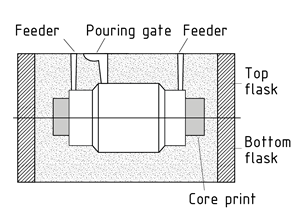
Casting is a Forming process used to produce primary and intermediate products (semi-finished products) that can be further processed through forming. A distinction is made between casting in a permanent mould and expendable mould. Casting materials are usually iron-Carbon compounds (cast iron, Steel), non-ferrous Metals such as copper, lead and nickel, light metals such as Aluminium and magnesium, or alloys. Other materials (e.g. plastic, plaster) can also be cast. Processes include, for example, Ingot casting in permanent moulds and continuous casting. The properties of castings are determined by the melt composition and casting structure in combination with the cooling rate, nucleation and crystal growth. Once the melt has been poured into the mould, solidification can be straight-walled, rough-walled and sponge-like (exogenous solidification) or shell-forming (endogenous). The volume of the casting reduces during this process. Feeders are added to compensate.
-
Example sentences:
- A distinction is made between casting in a permanent mould and expendable mould.
- The castings fall out of the mould once the vacuum is released.
- Afterwards, the shape and dimensions of the casting no longer resemble the original ingot.
mould casting
Description:
The aim of mould Casting is to use Forming processes to produce components and integral parts with almost identical dimensions and shapes in order to minimise chip removal and Assembly outlay. Additional operations such as Grinding, Drilling and Turning are used to give the moulded parts their final dimensions. Casting technology often involves the use of two-piece 'expendable moulds' that are based on models and designed to take Material shrinkage and Machining allowances into account. Moulds are made of highly refractory ceramics, natural, CO2 and synthetic-resin-sheathed sands or synthetic sands, which are usually bonded with resin or cement. Depending on the casting process, a wide range of parts from small to very large can be made from all kinds of castable Metals and alloys. Processes include Individual hand moulding Semi and fully automatic Machine moulding Suction moulding with optimum mould compaction Ceramic moulding Vacuum moulding Vacuum casting Investment casting Full-mould casting Centrifugal casting

moldeado
vaciado

模铸
Description:
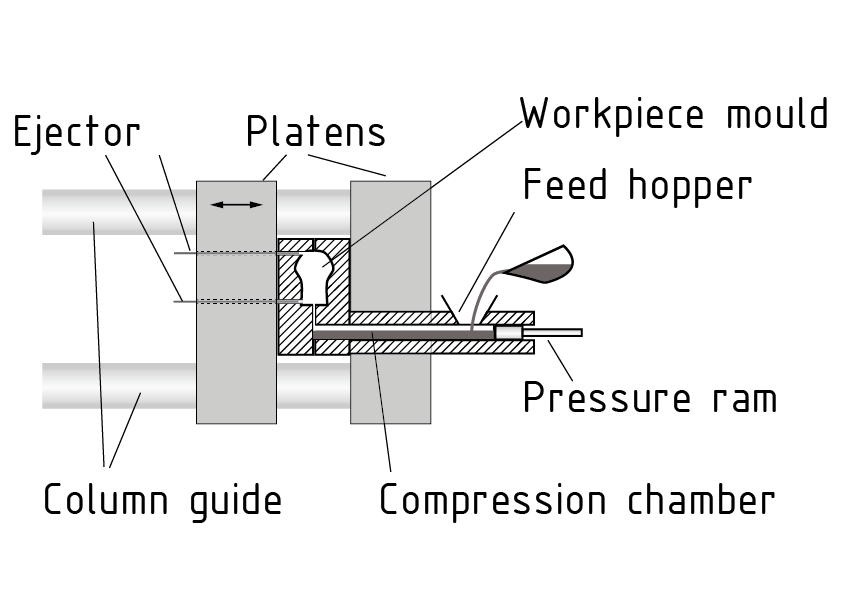
模,也被称为压(模)铸,是一种,其中熔融金属在高压下被高速压入加热的中并凝固。模铸最好使用低熔点的金属。 可以分为冷室压铸法(压力室位于熔融金属外部)和热室压铸法(压力室位于熔融金属中间)。 压铸机包括一个夹紧单元,用于打开和关闭压铸模具(可移动部分),还包括一个用于模具浇铸定位部分的固定压板、一个用于模具可移动部分的移动压板及一个喷射器。移动压板环柱状导轨。该机还具有一个进料口,一个带有挤压杆的压力室。 这种工艺可用于制造具有高表面质量的薄壁工件。还适用于系列和批量生产。 冷室压铸法 近义词 冷室压铸工艺 热室压铸工艺