
Guss
-
Beispielsätze:
- Unterschieden werden Gussverfahren in Dauerform und verlorener Form.
- Die Gussstücke fallen aus der Form, wenn das Vakuum abgeschaltet wird.
- Das Gussteil gleicht in Gestalt und Abmessungen anschließend dem ursprünglichen Block nicht mehr.

casting
Description:
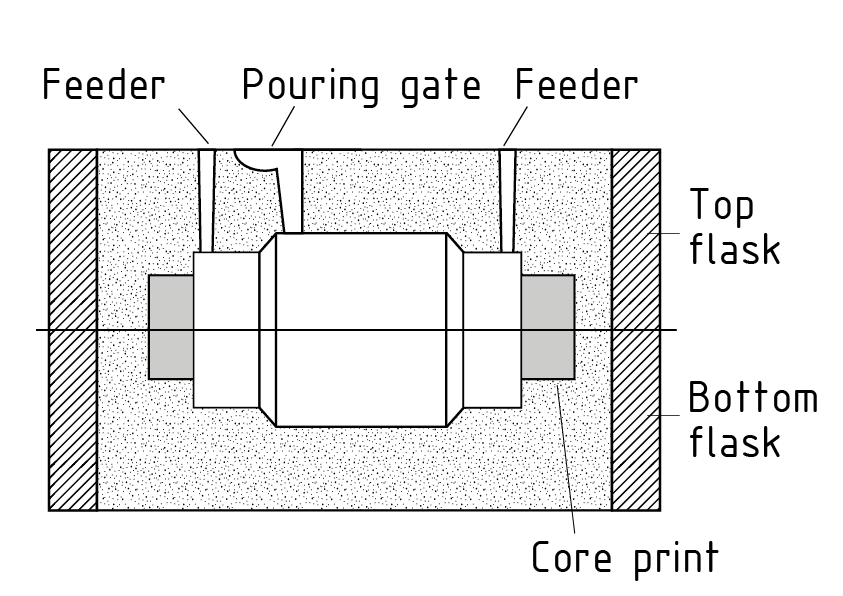
Casting is a Forming process used to produce primary and intermediate products (semi-finished products) that can be further processed through forming. A distinction is made between casting in a permanent mould and expendable mould. Casting materials are usually iron-Carbon compounds (cast iron, Steel), non-ferrous Metals such as copper, lead and nickel, light metals such as Aluminium and magnesium, or alloys. Other materials (e.g. plastic, plaster) can also be cast. Processes include, for example, Ingot casting in permanent moulds and continuous casting. The properties of castings are determined by the melt composition and casting structure in combination with the cooling rate, nucleation and crystal growth. Once the melt has been poured into the mould, solidification can be straight-walled, rough-walled and sponge-like (exogenous solidification) or shell-forming (endogenous). The volume of the casting reduces during this process. Feeders are added to compensate.
-
Example sentences:
- A distinction is made between casting in a permanent mould and expendable mould.
- The castings fall out of the mould once the vacuum is released.
- Afterwards, the shape and dimensions of the casting no longer resemble the original ingot.

vaciado

铸造
Description:
铸造是一种用于生产进一步加工的初步和中间产品(半成品)的成型工艺。可以分为永久模铸造和消失模铸造。 铸造用料通常是铁碳化合物(铸铁、钢)、有色金属(如铜、铅和镍)、轻金属(如铝和镁)或合金。还可以使用其他材料(如塑料、石膏)。 工艺方法包括永久模铸锭和连续铸造。 铸件的性能由熔体成分、铸造结构还有冷却速率、晶核形成和晶体生长共同决定。 一旦熔体被浇注到模具中,凝固过程可以是直壁、粗糙壁和海绵状(外生长凝固)或壳成型(内生长凝固)。在此过程中铸件的体积减少。通过进料器进行补偿。 消失模铸造