
Hooke'sche Gesetz

Hooke's law
Description:
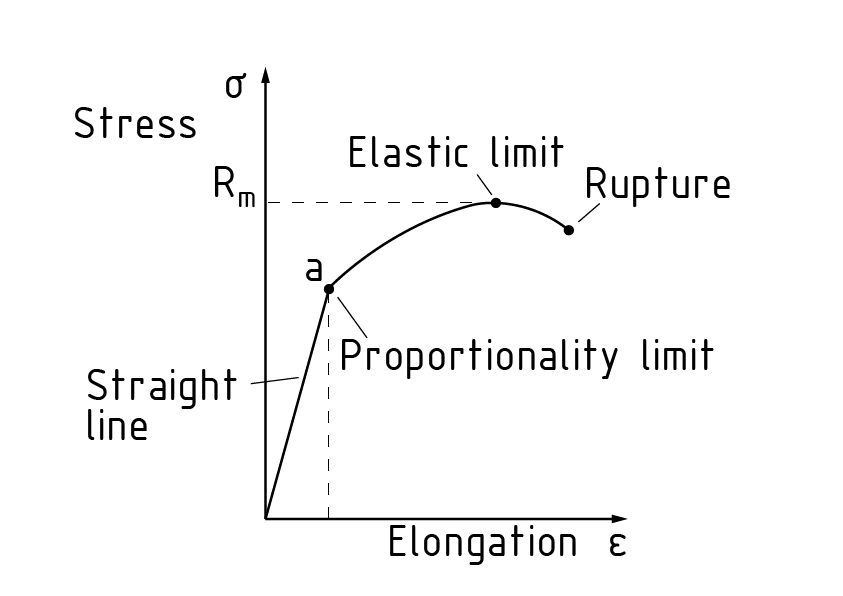
Hooke's law describes the linear-elastic behaviour of a Material when subjected to tension and compression. The formula $\sigma =E\cdot \varepsilon $ applies. Materials are deformed when forces act on them. When a test member starts to deform, the prevailing stress $\sigma $ is proportional to an elongation $\varepsilon $. This range is referred to as linear-elastic. In a stress-strain diagram, the straight line extends as far as the proportionality limit (point a). Hooke's law applies within this range. The slope of this straight line is called the Modulus of elasticity E (elastic modulus) and is a measure of the material's rigidity. Rigid materials such as Steel have a higher modulus of elasticity than ductile materials. Tensile tests are used as an experimental means of determining the modulus of elasticity E. The elongation, i.e. the change in the test member's length, is measured and the stresses are calculated based on the tensile Force acting on the member.