

I-Träger (Profile)

I-beam
Description:
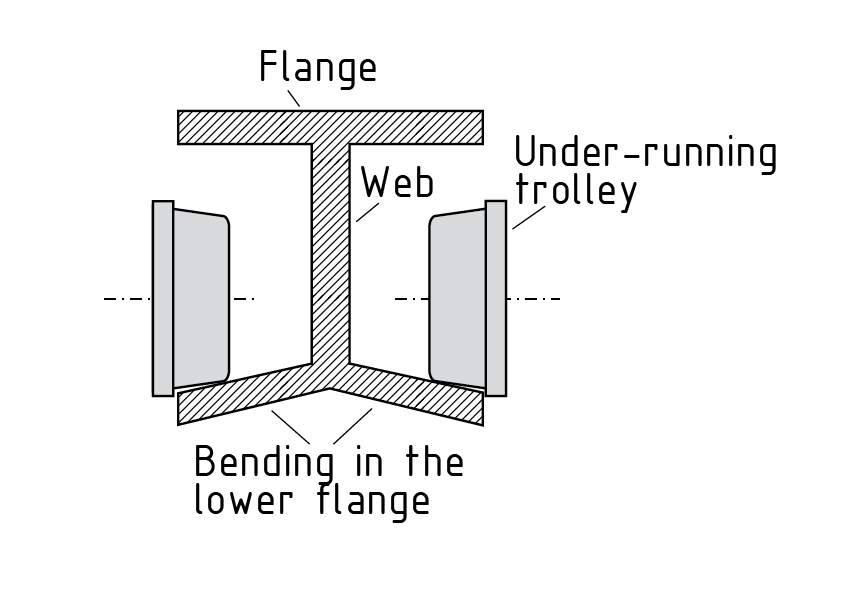
I-beams (double-T beams) are often used as structural elements in supporting structures. They comprise a middle part known as the web and a horizontal part (Flange) at both the top and bottom. A distinction is made between: S-type I-beams, which have narrower flanges that feature sloping surfaces on the inside W-type I-beams, which have wider, parallel flanges Wide flange beams in lightweight, Standard or heavy-duty Design GI-beam (reinforced mine support I-beam) I-beams can be rolled or welded. Rolled beams are cheaper and can usually withstand higher loads. Welded beams offer greater structural design freedom. In structures comprising I-beams, connections must have non-positive joints. Additionally, cross bracing can be welded in to ensure a more even distribution of loads. In the case of cranes, I-beams are often used directly as the runway for under-running trolleys. In this case, the localised Bending stresses that the under-running trolley exerts on the lower flange must be factored into the design of the supporting structure.
-
Example sentences:
- In the case of cranes, I-beams are often used directly as the runway for under-running trolleys.
- In structures comprising I-beams, connections must have non-positive joints.
- I-beams (double-T beams) are often used as structural elements in supporting structures.
rolled steel joist (profiles)

viga I
Description:
Las vigas I (vigas doble T) se usan a menudo como elementos estructurales en . Comprenden una parte media conocida como alma y una parte horizontal (patín) en la parte superior e inferior. Se debe distinguir entre: Vigas I tipo S, las cuales cuentan con patines más estrechos con superficies inclinadas en el interior Vigas I tipo W, las cuales cuentan con patines paralelos más anchos Vigas de patín ancho en diseños ligero, estándar y para trabajo pesado Vigas GI (viga I de soporte reforzado para minas) Las vigas I pueden ser laminadas o soldadas. Las vigas laminadas son más económicas y pueden soportar usualmente cargas más pesadas. Las vigas soldadas ofrecen una mayor libertad de diseño estructural. En las estructuras que constan de vigas I, las conexiones deben contar con uniones no positivas. Adicionalmente, se pueden soldar tirantes para asegurar una distribución de cargas más pareja. En el caso de las , las vigas I son a menudo usadas directamente como guía para los carros de rodamiento inferior. En este caso, los esfuerzos de flexión que ejercen los carros de rodamiento inferior sobre el patín inferior deben ser contabilizados en el diseño de la estructura de soporte. Viga I de una grúa con carro de rodamiento inferior
vigueta de acero laminado (perfiles)