
Lageenergie

position energy
potential energy
Description:
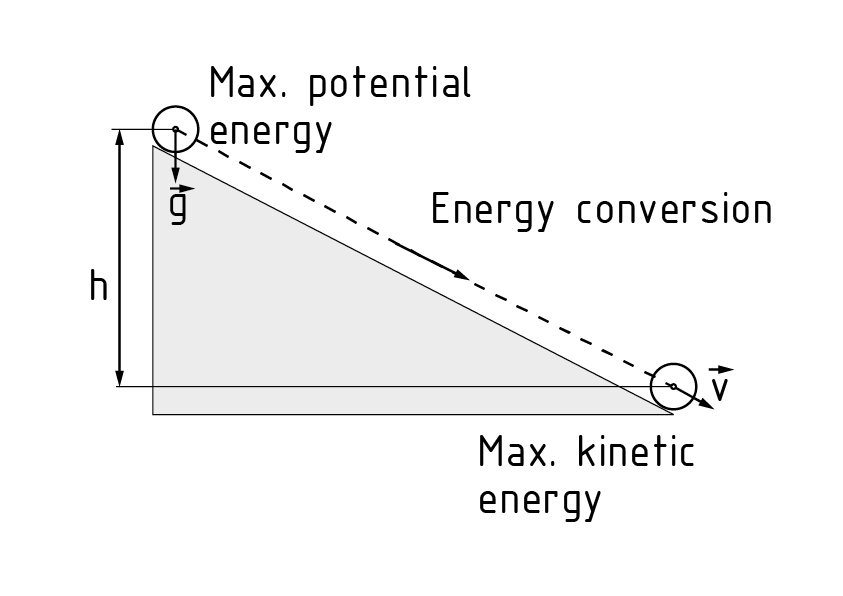
Potential energy ${{E}_{pot}}$ is the energy content resulting from the height displacement h of a body with a mass m. When displaced against gravitational acceleration, the energy content is regarded as positive. Displacing a body towards the ground results in a loss of potential energy and causes it to be converted into one or more forms of energy (Kinetic energy, for example). Potential energy is calculated based on the height h, weight g and mass m: ${{E}_{pot}}=m\cdot g\cdot h$. The energy is measured in J (joules) or Nm (newtonmetres). The height value h is related to the path of lift (in the z direction) for the body. This action involves lifting Work that corresponds to the potential energy. The deflection of a body under the effect of a tensioned spring can also increase the potential energy. This energy can be calculated on the basis of the spring constant.
-
Example sentences:
- This potential energy content is stored in the deformed body.
- This action involves lifting work that corresponds to the potential energy.
- The deflection of a body under the effect of a tensioned spring can also increase the potential energy.

energía de posición

势能
Description:
势能 ${{E}_{pot}}$ 是指质量为m的物体由于高度位置变化h所形成的内能。当克服重力加速度移动时,内能为正。沿重力方向移动时,物体势能减少并转化成其它形式的能量(例如动能)。 势能可由高度h、重力加速度g和质量m计算得到: ${{E}_{pot}}=m\cdot g\cdot h$ 。能量以J (焦耳)或Nm (牛顿米)来计量。高度值h是指物体距水平面(在Z方向)的高度。势能变化的同时也涉及到上升功的改变。 hh在压缩弹簧作用下物体产生的挠曲可以增加势能。这个能量可以弹簧常数为基础计算得到。 从势能转化为动能