

legieren
-
Beispielsätze:
- Durch Legieren der Werkstoffe kann das Kriechen in der Praxis reduziert werden.

alloy
Description:
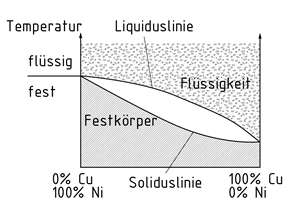
An alloy is a metallic Material comprising at least two constituents that form a metallic bond. Depending on the number of constituents, this produces binary, ternary, quaternary or complex alloys. Alloying changes the properties of Metals and gives them a specific profile of properties that is determined by the mutual absorbability of the alloying constituents (solubility) and the type of crystals formed (substitutional solid solutions, interstitial solid solutions, combinations of mixed and primary crystals, intermetallic phases). The type of crystallisation is influenced by the type and number of alloying elements, their mass fractions and the temperature. Most alloys solidify in a mushy zone between the solidus temperatures of the individual constituents. Eutectic alloys, which have a fixed melting point, are one exception. The metals with the highest solidus temperature crystallise from a melt first. As cooling continues, the composition of the mixed crystals becomes more like the constituent with the lower solidus temperature. As the crystals slowly cool, their composition also continuously changes as a result of diffusion. The faster the cooling, the more fine-grained the (micro)structure. The steps involved in making an alloy are depicted in phase diagrams. Alloys are identified by stating their main component followed by their characterising constituents. A distinction is made between ferrous and non-ferrous alloys. Pseudoalloys are sintered metal powders.
-
Example sentences:
- Reverse Unit housing and Coupling Housing made from high-strength aluminium alloy.
- The workpiece usually consists of metal, metal alloys or composite materials.
- The aluminium alloy is resistant to weathering and many chemicals.