
Schutzgasschweißen
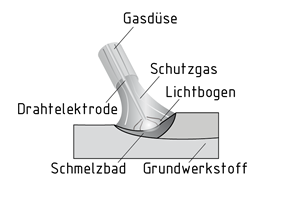
Das Schutzgasschweißen ist eine Fügetechnik für unlösbare Metallverbindungen. Es ist ein Lichtbogenschweißverfahren, bei dem ein Schutzgas die entstehende Schmelze so abdeckt, dass sie gegen Oxidation mit Luftsauerstoff geschützt ist und das Anlaufen der Schweißnaht vermieden wird. Nötig sind dabei zudem abschmelzende Schweißzusatzwerkstoffe in Form von speziell legierten Schweißdrähten oder auch mit Zusätzen wie Schlackebildnern gefüllte Röhrchendrähte.
Der Lichtbogen wird gezündet, indem die Elektrode (Schweißdraht) das Werkstück kurz berührt und so einen Kurzschluss erzeugt. Dann wird der Schmelzdraht gemeinsam mit der Schutzgas-Düse über die gewünschten Fügestellen des Werkstücks geführt.
Lediglich beim Wolfram-Schutzgasschweißen schmilzt die Elektrode nicht ab. Bei diesem Verfahren darf der Lichtbogen nicht durch Kontakt mit der Wolframelektrode gezündet werden. In der Regel wird der Lichtbogen durch eine berührungslose Hochfrequenzzündung erzeugt.
Unterschieden werden:
- Metallschutzgasschweißen mit inerten, also reaktionsarmen Gasen (MIG), bei dem das Schutzgas ein inertes Edelgas wie Argon oder Helium ist
Metallaktivgasschweißen (MAG), bei dem das Schutzgas aus reinem oder einem Mischgas aus Argon, und (Corgon) besteht

inert arc welding
protective gas welding
Shielded arc welding
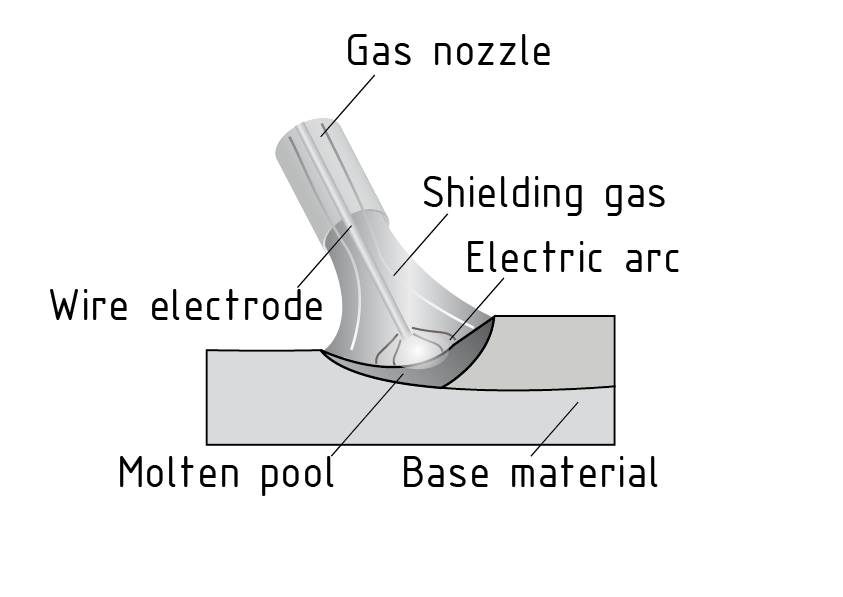
Shielded arc welding is a Joining technology for permanent metal bonds. In this electric arc Welding method, a shielding gas covers the melt that is created in order to protect it against oxidation with atmospheric oxygen and prevent the Weld seam from becoming tarnished. This method requires the use of melting filler materials in the form of specially alloyed welding wires or tubular wires with fillers such as slag-Forming agents.
The electric arc is ignited by a short-circuit created when the electrode (welding wire) briefly touches the workpiece. The wire is then guided together with the gas nozzle over the required Joint locations on the workpiece.
Only in the case of tungsten inert-Gas welding does the electrode not melt. When using this method, the electric arc must not be ignited through contact with the tungsten electrode. It is normally created using contactless high-frequency ignition.
A distinction is made between:
- Metal inert gas welding (MIG), which uses an inert, or low-reaction, gas such as argon or helium as the shielding gas
Metal active gas welding (MAG), which uses pure or a mixture of argon, and (corgon) as the shielding gas
Shielded arc welding
Shielded arc welding is a Joining technology for permanent metal bonds. In this electric arc Welding method, a shielding gas covers the melt that is created in order to protect it against oxidation with atmospheric oxygen and prevent the Weld seam from becoming tarnished. This method requires the use of melting filler materials in the form of specially alloyed welding wires or tubular wires with fillers such as slag-Forming agents.
The electric arc is ignited by a short-circuit created when the electrode (welding wire) briefly touches the workpiece. The wire is then guided together with the gas nozzle over the required Joint locations on the workpiece.
Only in the case of tungsten inert-Gas welding does the electrode not melt. When using this method, the electric arc must not be ignited through contact with the tungsten electrode. It is normally created using contactless high-frequency ignition.
A distinction is made between:
- Metal inert gas welding (MIG), which uses an inert, or low-reaction, gas such as argon or helium as the shielding gas
Metal active gas welding (MAG), which uses pure or a mixture of argon, and (corgon) as the shielding gas
shielded welding
shielded-arc welding

soldadura a gas protector
soldadura de arco inerte
soldadura de arco protegida
soldadura protegida

气体保护焊
气体保护电弧焊
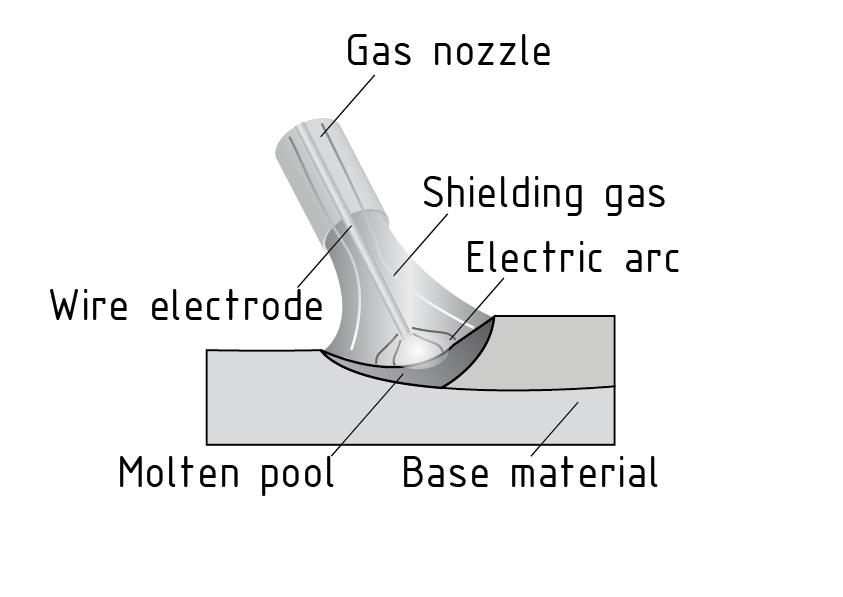
气体保护电弧焊是一种形成永久金属键的连接技术。在这种电弧焊接方法中, 使用保护气体来覆盖产生的熔体,以隔离大气中的氧气使其不被氧化,并防止锈蚀焊缝。此方法需要使用熔化填充材料,可以是特殊合金的焊丝或带有填充剂(如成渣剂)的管丝。
电极(焊丝)和工件之间的点触造成短路,用于引燃电弧。然后通过焊炬喷嘴在工件上所需连接位置喷射焊丝熔体。
仅在钨极惰性气体保护焊的情况下,电极不熔化。当使用这种方法时,电弧不能通过与钨极的接触被点燃。通常可以利用非接触式高频点火来创建。
可以分为:
金属极惰性气体保护焊 (MIG),它使用一种惰性或反应活性差的气体作为保护气体,如氩气或氦气
金属极活性气体保护焊 (MAG),它使用纯的 ${CO_2} $ 或氩气、${CO_2} $ 和${O_2} $ 的混合物(科焊刚)作为保护气体
气体保护电弧焊
近义词
MIG
金属极活性气体保护焊
MAG
气体保护电弧焊
气体保护电弧焊是一种形成永久金属键的连接技术。在这种电弧焊接方法中, 使用保护气体来覆盖产生的熔体,以隔离大气中的氧气使其不被氧化,并防止锈蚀焊缝。此方法需要使用熔化填充材料,可以是特殊合金的焊丝或带有填充剂(如成渣剂)的管丝。
电极(焊丝)和工件之间的点触造成短路,用于引燃电弧。然后通过焊炬喷嘴在工件上所需连接位置喷射焊丝熔体。
仅在钨极惰性气体保护焊的情况下,电极不熔化。当使用这种方法时,电弧不能通过与钨极的接触被点燃。通常可以利用非接触式高频点火来创建。
可以分为:
金属极惰性气体保护焊 (MIG),它使用一种惰性或反应活性差的气体作为保护气体,如氩气或氦气
金属极活性气体保护焊 (MAG),它使用纯的 ${CO_2} $ 或氩气、${CO_2} $ 和${O_2} $ 的混合物(科焊刚)作为保护气体
气体保护电弧焊
近义词
MIG
金属极活性气体保护焊
MAG