
Verschiebesatz
-
Beispielsätze:
- Es entsteht jedoch laut des Verschiebesatzes nicht bei Verschiebung einer Kraft entlang ihrer Wirkungslinie, da Kräfte linienflüchtige Vektoren sind.

parallel-axis theorem
Description:
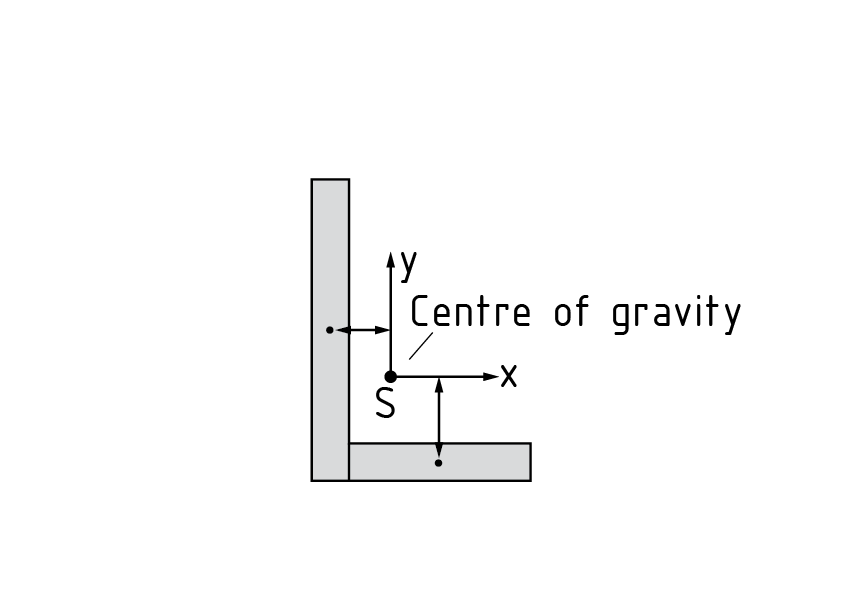
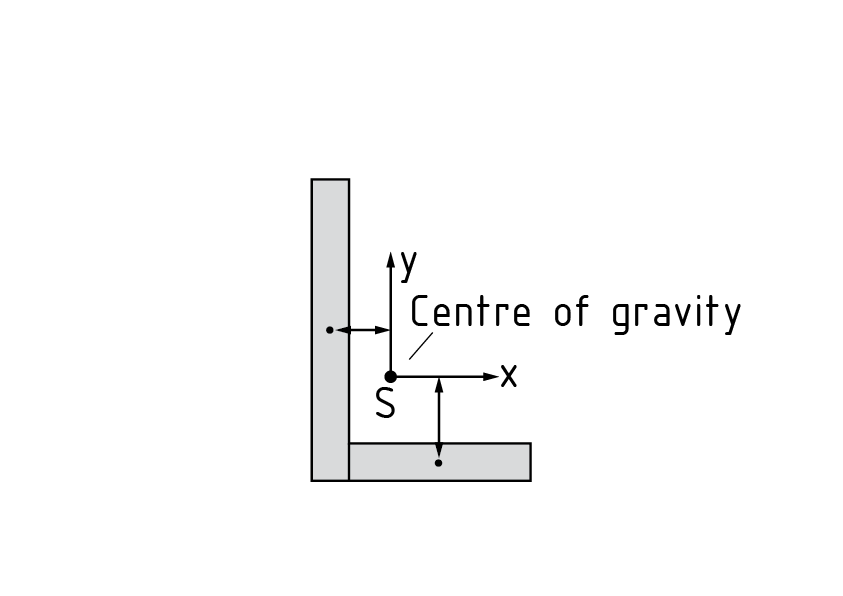
The parallel-axis theorem (Steiner's theorem) is used to transform area moments of inertia onto an axis running parallel to the centroid (gravity) axis. In the case of components comprising composite cross-sectional areas, the parallel-axis theorem can be used to determine the area moments of the full cross-sections. The Area moment of inertia of a composite cross-section (see diagram with example of L section) is calculated as follows: Split the full cross-section into simple cross-sectional shapes (e.g. square, triangle, circle) Determine the individual centres of gravity Calculate the area moments of inertia (of the relevant cross-sections) or obtain these values from appropriate tables (${{I}_{y~}}$and ${{I}_{z~}}$) Transform the relevant area moments of inertia using the parallel-axis theorem: \[{{I}_{{\bar{y}}}}={{I}_{y}}+\bar{z}_{s}^{2}A\], ${{I}_{{\bar{z}}}}={{I}_{z}}+\bar{y}_{s}^{2}A$, \[{{I}_{\bar{y}\bar{z}}}={{I}_{yz}}-\bar{y}_{s}^{{}}\bar{z}_{s}^{{}}A\] $\bar{z}_{s}^{2}A$ and \[\bar{y}_{s}^{2}A\] are both called the Steiner's share. The relevant area A is multiplied by the square of the distance between the individual and common centres of gravity. Adding up the relevant transformed area moments of inertia to obtain a total area moment of inertia indicates the area moment of the full cross-section
-
Example sentences:
- The parallel-axis theorem (Steiner's theorem) is used to transform area moments of inertia onto an axis running parallel to the centroid (gravity) axis.
- In the case of components comprising composite cross-sectional areas, the parallel-axis theorem can be used to determine the area moments of the total cross-sections.
- However, the parallel-axis theorem states that offset moment is not produced when a force is moved along its line of action, because forces are sliding vectors.
Steiner's theorem
-
Example sentences:
- The parallel-axis theorem (Steiner's theorem) is used to transform area moments of inertia onto an axis running parallel to the centroid (gravity) axis.

teorema de eje paralelo
teorema de Steiner

平行轴定理
Description:
平行轴定理 (史丹纳定理)可以从质心(重心)的面积惯性矩,计算出任一平行于质心的轴上的面积惯性矩。对于包含有多种横截面的构件,平行轴定理可用于确定所有截面上惯性矩的合矩。 包含有多种横截面的构件(见图中的 L 型构件)的面积惯性矩计算如下: 将全部横截面拆分为简单的横截面形状(如正方形,三角形,圆形) 确定各自的重心 计算各自(相关截面)的面积惯性矩或从合适的表 ( ${{I}_{y~}}$ 和 ${{I}_{z~}}$ )中选取数值 使用平行轴定理进行面积惯性矩的转换计算: ${{I}_{{\bar{y}}}}={{I}_{y}}+\bar{z}_{s}^{2}A$, ${{I}_{{\bar{z}}}}={{I}_{z}}+\bar{y}_{s}^{2}A$, ${{I}_{\bar{y}\bar{z}}}={{I}_{yz}}-\bar{y}_{s}^{{}}\bar{z}_{s}^{{}}A$ $\bar{z}_{s}^{2}A$ 和 $\bar{y}_{s}^{2}A$ 都被称为史丹纳面。面积元素 A 乘以各自重心和公共重心间距离的平方。 将各个截面的面积惯性矩进行积分求和运算,得到所有截面的总体面积惯性矩。 多种横截面的面积惯性矩